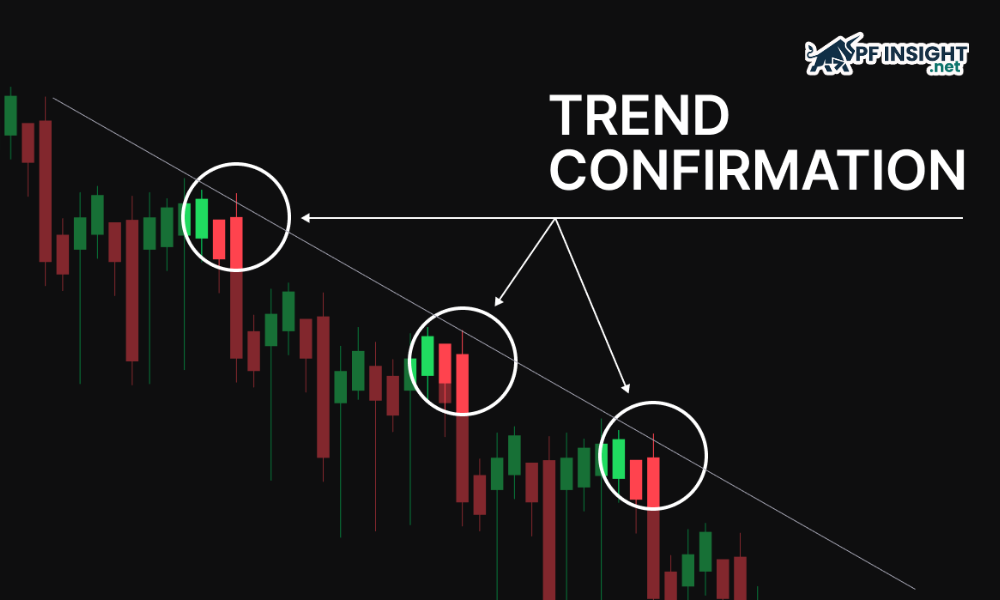
Many traders incur losses not because they lack a strategy, but because they ignore trend & confirmation when entering trades. Markets tend to move in trends, and only when those trends are clearly confirmed do trading opportunities become truly high quality. Understanding and applying trend & confirmation correctly helps traders trade more systematically, maintain discipline, and avoid risky attempts to “catch tops and bottoms.
A trend reflects the main direction of price movement over a specific period. Markets rarely fluctuate completely randomly; they usually form distinct trends such as uptrends, downtrends, or sideways movements.
In technical analysis, trends are categorized into three basic groups.
Uptrend: Defined when the price consistently creates higher highs (HH) and higher lows (HL). This is when the buyers are in complete control.
Downtrend: Conversely, the price creates lower highs (LH) and lower lows (LL). Sellers are exerting immense pressure.
Sideways: Price moves within a range, with no clear high or low peaks. This is often the “accumulation” phase for large institutions.
What is confirmation in trading?
Confirmation is a signal that helps confirm that the market is moving in accordance with the trading scenario that the trader has developed. Thanks to confirmation, traders avoid entering trades too early or trading against the main trend. In fact, many people lose money because they rush into trades when they see a breakout, when it is only a false breakout or a bull/bear trap.
Confirmation acts as a signal filter, reducing noise in volatile price zones. When traders patiently wait for price action to confirm the signal, their win rate improves and FOMO (fear of missing out) is more effectively controlled.
Simply put, trend & confirmation complement each other in trading. Trends help traders determine the appropriate trading direction, while confirmation acts as a guarantor of a safe and high-probability entry point.
The importance of trend & confirmation in trade entry decisions
In financial trading, identifying trends and seeking confirmation are not just simple technical steps, but also a “shield” protecting your account from the unpredictable fluctuations of the market. Below are the reasons why trend and confirmation play a crucial role in the success or failure of a trader.
The importance of trend & confirmation in trade entry decisions
Avoid trading against the trend
Most of the time, the market moves in a certain trend, so trading against the trend without confirmation often carries high risk. Trying to catch tops or bottoms without clear confirmation easily leads to losses for traders. Conversely, trading with the trend is like swimming downstream, saving energy and achieving better results.
Higher probability of winning: When the market is in a clear uptrend, the buyers are in control. Opening a buy position at this time will have a much higher probability of success than trying to “catch the peak” to sell short.
Profit optimization: Trends provide momentum. Once the market has formed a pattern of higher highs following higher highs, the price tends to continue that upward momentum, allowing you to hold your position longer and achieve an ideal risk/reward ratio (R:R).
Confirm the entry point
If the trend tells you the direction, then confirmation tells you the timing. Entering a trade as soon as the price touches a support or resistance zone without confirmation is often likened to “catching a falling knife.”
Eliminate noise signals: The market frequently creates false breakouts (fakeouts) to trigger stop-loss orders from retail traders. Confirmation from candlestick patterns (such as Pinbar, Engulfing) or technical indicators (RSI, MACD) helps you verify whether buying/selling pressure has actually returned to that price level.
Boosting confidence: When you have 2-3 additional factors supporting a scenario (known as confluence), your trading psychology will be more stable. You will no longer feel anxious or compelled to exit trades early due to a lack of justification.
Maintain a stable trading mindset
Trading is not simply about analyzing data, but also a test of a trader’s psychology. Ignoring trend & confirmation, many people rush into trades due to FOMO (fear of missing out) or try to trade against the trend just to prove their personal opinion, leading to undisciplined decisions.
Trend & confirmation trading not only increases the probability of winning but also helps traders better control their emotions. When all decisions are based on clear trends and confirmation signals, traders will be less panicked by short-term fluctuations. As a result, impulsive behaviors such as revenge trading or chasing the market due to FOMO are significantly reduced.
Trend & confirmation toolset for trading
To effectively trend & confirmation, traders can use the following indicators:
Trend & confirmation toolset for trading
Average Directional Index (ADX)
ADX is a popular tool that helps traders determine the strength of a trend rather than the direction of price movement. As the ADX value increases, it reflects a clearer market trend. This indicator has a scale from 0 to 100 and is often used to distinguish between strong trending markets and sideways phases.
The ADX is not just a single line but comprises three separate lines: ADX, +DI, and -DI. The crossover between +DI and -DI indicates the direction of price movement, where +DI higher than -DI signals an uptrend, while -DI higher than +DI indicates a downtrend. The ADX line plays a role in assessing trend strength; exceeding 25 indicates a clear market trend.
SAR parabolic
Parabolic SAR is a popular tool used to confirm trends and detect potential reversals. On MT4, this indicator is represented by a series of dots that move with the price, positioned below during an uptrend and above during a downtrend, thus helping traders track trend changes.
When applying trend & confirmation, Parabolic SAR helps clarify the market direction. SAR dots appearing below the price signal an uptrend, while moving above the price indicates a downtrend. Based on the reversal of these dots, traders can systematically identify potential trend-following trading points.
Moving average (MA)
Moving Averages (MA) are a familiar trend-following tool in technical analysis, available on MT4. By calculating the average price over a defined period, MAs help smooth price movements and support the identification of the underlying trend instead of being affected by small fluctuations.
On a chart, the Moving Average (MA) appears as a trend line reflecting the average price over time. If the price moves above the MA line, it signals an uptrend; conversely, when the price is below the MA, a downtrend is usually confirmed. Popular periods such as 50, 100, or 200-period MAs allow traders flexibility in applying them to both short-term and long-term trading.
Ichimoku Kinko Hyo
Ichimoku Kinko Hyo is a powerful tool in trend and confirmation strategies, providing an overall view of market conditions. Through components such as Tenkan-sen, Kijun-sen, and Senkou cloud, traders can identify trends, key price zones, and momentum strength all within a single indicator.
The Ichimoku Kinko Hyo indicator is designed to provide a comprehensive view of trends through the combination of multiple moving averages. The area between Senkou Span A and Senkou Span B forms a cloud, acting as dynamic support and resistance zones over time. Price moving above the cloud usually reflects a clear uptrend, while a break below the cloud indicates a bearish market.
Common mistakes when ignoring trends and confirmation
Ignoring trend & confirmation is a common reason why traders trade against the market, constantly getting their stop losses hit, and losing discipline. Below are some common mistakes traders often make:
Common mistakes when ignoring trends and confirmation
Catching the bottom and top against the trend
A common mistake traders make is trying to predict the top of an uptrend or buy the bottom when the market is in a sharp decline. In reality, trends can last much longer than personal predictions suggest. By ignoring trend and confirmation and entering trades against the direction without clear confirmation signals, traders are very likely to experience repeated stop-loss hits and fall into emotional trading.
Trading based on only a single indicator
Many traders place absolute faith in a single technical indicator like RSI, MACD, or Stochastic, ignoring the overall trend context. No single indicator is strong enough to trade independently in all market conditions. Indicators should only be used as confirmation signals, not as the sole basis for entering trades if the trend is not clearly defined.
Confusing pullback with reversal
In strong trends, pullbacks are a frequent occurrence before prices continue in the main direction. However, without applying trend & confirmation, many traders hastily assume the market has reversed and enter trades against the trend. The lack of clear confirmation signals quickly leads to losses when the old trend continues.
Overtrading due to lack of discipline
Failing to wait for clear trend & confirmation often leads to overtrading – entering trades continuously out of fear of missing opportunities. Without specific confirmation rules, traders are prone to FOMO, trading too much and losing control of risk. The ultimate consequence is large drawdowns, weakened trading sentiment, and rapid account liquidation.
How to optimize trading by combining trend and confirmation
Applying the right trend and confirmation is key to disciplined trading, limiting risk, and avoiding emotional decisions.
How to optimize trading by combining trend and confirmation
Always perform multi-timeframe analysis (MTF)
Multi-timeframe analysis is a crucial skill for sustainable trend and confirmation trading. Traders should start with larger timeframes (D1, H4) to identify the market’s main trend, then move down to smaller timeframes (H1, M15) to find optimal entry points. This helps avoid trading against the major trend and filters out many noise signals. A good setup is when the trend on the larger timeframe and the confirmation on the smaller timeframe align.
Select only the necessary indicators instead of using too many
A common mistake many traders make is using too many indicators at once, leading to signal confusion and inconsistency. In reality, you only need 2–3 effective confirmation tools, for example: MA to identify trends, RSI or MACD to confirm momentum, combined with price action. The important thing isn’t the number of indicators, but understanding how they react in different market contexts.
Record winning and losing trades to optimize your strategy
A trading journal is the fastest way for traders to improve their skills. After each trade, record: the reason for entering the trade, the trend on the larger timeframe, the confirmation signal used, the result, and your feelings during the trade. Over time, you will recognize recurring patterns in winning trades and common mistakes in losing trades, thereby refining your trend and confirmation strategy to become increasingly accurate.
Maintain discipline and manage your emotions
Even with accurate trend identification and clear confirmation, trades can still fail if traders lack discipline. Entering trades outside of the plan, arbitrarily moving stop losses, or trading based on emotions (FOMO, revenge trading) will negate all the advantages of trend and confirmation. Successful traders are those who adhere strictly to their trading plan, accept small losses, and maintain a stable mindset in all market conditions.
Conclude
Effective trading does not come from placing many trades, but from entering at the right time. According to pfinsight.net, applying trend & confirmation helps traders choose the correct trading direction, control their emotions, and maintain long-term discipline. When traders clearly understand why they enter a trade and stick to their plan, they can avoid FOMO and gradually build a stable, sustainable trading strategy.