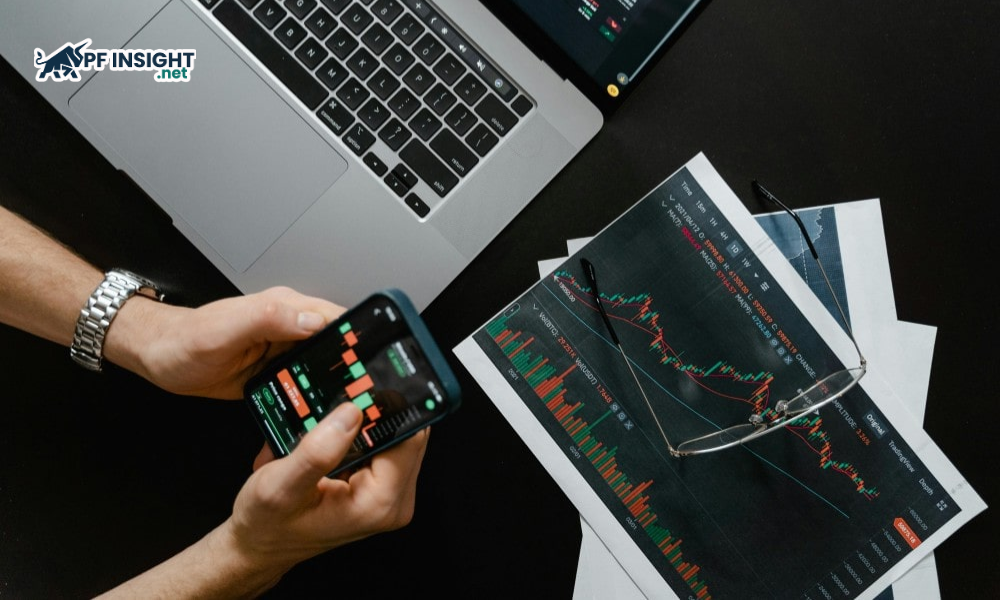

Trading discipline is an important factor that helps traders maintain long-term consistency. With the right trading discipline tips, you can limit emotion-driven decisions, avoid breaking rules, and keep performance consistent over time. In this article from Pfinsight.net, you will learn practical trading discipline tips to stay consistent in the long run.
- Backtesting trading strategies and how traders evaluate historical performance
- Forward testing trading and why it matters after backtesting results
- Algorithmic trading basics for traders moving from manual to systematic trading
Why trading discipline matters more than strategy

Trading is not short of good strategies; what is often missing is the ability to execute those strategies consistently. In this section, we will clarify why discipline is the key factor that helps traders turn an edge into stable results over time.
Strategy gives you an edge, discipline lets you realize it
A good strategy only gives you a statistical edge, but that edge only turns into real results when you execute it correctly and consistently. Trading is fundamentally a probability game: even a perfect setup can lose, and even an average trade can win. That is why what matters is not having a “guaranteed winning trade,” but having enough discipline to repeat the right process across dozens or even hundreds of trades.
In other words, strategy is just probability, while discipline is what prevents you from breaking the system. Just a few trades taken outside the plan, holding losses against your rules, or increasing position size based on emotions can quickly erode your strategy’s edge. Discipline is what transforms an edge on paper into stable performance over time.
The hidden cost of inconsistency
Lack of consistency in trading often does not show up clearly at the beginning, but it quietly “eats away at your account.” When traders fail to control themselves, they are more likely to fall into overtrading, revenge trading, or FOMO (fear of missing out). These behaviors push traders to sacrifice their original plan in exchange for the feeling of “doing something,” and they often lead to poor-quality decisions.
The most dangerous point is when you start breaking risk management rules: moving your stop-loss, increasing position size unusually, or failing to accept a loss at the right time. The result is higher account volatility, unstable profits, and a gradual loss of control. Over the long run, inconsistency not only reduces performance but also destroys your confidence in the very system you are using.
The core principles of trading discipline
Discipline in trading is not a feeling of “being motivated today,” but a clear system of rules that helps you act correctly even when your emotions fluctuate. When you truly understand the nature of discipline, you will no longer rely on temporary willpower, but instead maintain consistency as a structured process.
Process over outcome
A common mistake among traders is evaluating a trade solely based on PnL (profit/loss). In reality, a profitable trade can still be a wrong trade if you entered impulsively, ignored rules, or took on risk recklessly. On the other hand, a losing trade can still be the right trade if you followed every step of the plan and accepted the probabilistic outcome.
That is why the most important principle of discipline is prioritizing process over results. You need to learn to evaluate yourself by asking “Did I follow the rules?” rather than “Did I win?”. When you measure adherence, you can build real consistency, and profits will come as a consequence.
Risk management is the backbone of discipline
If discipline is a house, risk management is its foundation. Many traders think discipline means “controlling emotions,” but in reality emotions tend to surge most when risk is loose. When you do not know how much you could lose, your mindset can easily shift into panic or reckless behavior.
To make discipline solid, you need to turn risk management into a non-negotiable rule set, including:
- Fixed risk per trade: each trade risks only a specific percentage (for example 0.5%–1%), without increasing or decreasing based on emotions
- Daily loss limit: a maximum loss threshold for the day, and once reached, you stop trading immediately
- Weekly risk cap: a weekly limit on risk or drawdown to prevent “chasing losses” over multiple days
When risk is locked in through a system, discipline becomes much easier to maintain because you remove the situations that trigger rule-breaking.
Consistency is repeatable decision-making
Many people misunderstand “consistency” as meaning you must always win or make a profit every single week. But trading does not work that way. The outcome of each trade or each week always contains noise, because this is a probability-based game. Therefore, consistency does not mean winning every trade.
True consistency is the ability to make repeatable decisions under the same standards: under the same conditions, you act the same way; within the same system, you follow it the same way. You can only achieve consistency when you standardize entries, risk management, and the review process. In short, a consistent trader is not someone who is always right, but someone who always follows the process.
Trading discipline tips you can apply immediately

Trading discipline does not have to start with huge changes. In fact, traders who maintain long-term consistency often rely on simple rules applied consistently every day. Below are practical trading discipline tips you can implement immediately to reduce mistakes and keep performance more stable.
Use a pre-trade checklist
One of the fastest ways to improve discipline is using a pre-trade checklist before every trade. A checklist helps eliminate impulsive decisions and forces you to evaluate a trade based on standards rather than emotions. Just 30–60 seconds of checking before clicking buy/sell can save you from many trades that are simply not worth taking.
A basic checklist should include three groups:
- Setup quality: Does the trade match the model/conditions you defined? Is it an A-setup, or does it only “look okay”?
- Risk check: Where is the stop-loss placed, what is the risk percentage, and does the minimum RR meet your requirement? Does it exceed your daily risk limit?
- Emotional state check: Are you feeling rushed, afraid of missing out, or trying to recover from the previous trade? If the answer is yes, there is a high chance you should stay out.
If a trade does not pass the checklist, the best rule is: no checklist, no trade.
Set non-negotiable daily loss limits
A daily loss limit is a “safety brake” that protects both your account and your mindset. Many traders break discipline not because they lack knowledge, but because after losing 2–3 trades, they enter a recovery mindset and make a series of poor decisions. A daily loss limit helps you cut the mistake streak as soon as it starts.
To apply it effectively, you need:
- Hard stop rule: once you hit the maximum loss for the day, stop trading immediately, no negotiation
- The right mindset: “stop trading when wrong”: This means that when the market conditions that day do not suit you, the most disciplined action is not placing more trades, but stepping away to protect both capital and mental stability.
One day of stopping at the right time is often far more valuable than a day of forcing recovery and breaking discipline.
Reduce decision fatigue
Every day, traders deal with too many choices: enter or not, increase size or not, exit or hold longer. As the number of decisions increases, the chance of making emotion-driven mistakes also rises. That is why undisciplined traders often become more exhausted the more they trade, and by the end of the day, they tend to break rules.
The solution to reduce decision fatigue is simple:
- Fewer setups, fewer markets: focus on fewer markets and fewer setup types
- Trade only A+ setups: if it is not a clear opportunity by your standards, skip it
Cutting down choices does not make you lose opportunities. It improves decision quality and makes discipline easier to maintain.
Trade only within defined sessions
A very common habit that destroys discipline is boredom trading: staring at charts all day and entering trades because you “have nothing to do,” or because you feel you must find a trade. This often leads to low-quality trades and increases overtrading.
The solution is setting a clear time window:
- Define a time window: you only trade during fixed hours (for example, the London open or the New York session)
- Outside that window: no trade hunting, no entries
When the session ends, you close the charts. Time limits reduce impulsiveness, lower fatigue, and help you stay consistent over time.
Use position sizing rules to prevent impulsive risk
Many discipline mistakes start with uncontrolled position size increases. Traders often size up after a few wins due to overconfidence, or after a loss because they want to recover quickly. Both are impulsive risks that break the system.
To prevent this, you need clear sizing rules:
- Fixed % risk: each trade risks a fixed percentage of the account
- No sudden size increase: do not increase size suddenly, only scale up according to a plan (for example, after 20–30 rule-following trades with stable results)
Proper position sizing not only protects your account, but also protects discipline because it prevents “big emotions” when money swings too sharply.
A daily routine to stay consistent

If you want sustainable consistency, discipline needs to be “packaged” into a daily routine. A routine removes the need to rely on inspiration or motivation, because each day you simply repeat a fixed process. This is also how professional traders reduce psychological mistakes: they do not try to “be more disciplined,” they build a system where discipline becomes the default.
Pre-market routine (10 – 20 minutes)
Pre-session preparation helps you enter the market proactively instead of reacting impulsively. Just 10–20 minutes done properly can significantly reduce emotional decisions during the session. A pre-market routine can include:
- Market scan: quickly scan the markets you trade to identify the overall context (trend/range, volatility)
- Key levels: mark important price zones (support/resistance, supply/demand, HTF levels)
- Scheduled news check: check the economic calendar (CPI, NFP, FOMC, etc.) to avoid entering trades during abnormal volatility
- Define today’s “no trade conditions”: set clear “no trade” conditions for the day (for example: unusually high spreads, overly choppy markets, unstable mindset)
During trading routine
During the session, the main goal is to reduce noise and keep yourself in “execution mode.” Traders lose discipline not because they lack strategy, but because they repeatedly break the process as soon as the market moves differently than expected. Your in-session routine should focus on:
- Execution script: a fixed procedure for each trade (checklist → entry → stop-loss → take-profit → trade management)
- Rules for entries/exits: enter only when conditions are met; exit according to predefined rules (do not change rules mid-trade)
- Limit number of trades/day: cap the number of trades per day to prevent overtrading (for example: maximum 2 – 3 trades)
You can also add a highly effective rule: after a losing trade, take a 5 – 10 minute break before considering the next one. This short pause dramatically reduces revenge trading.
Post-market review routine
Post-session review is where discipline is “accumulated.” Traders struggle with consistency not because they do not try hard enough, but because they lack a clear feedback loop, so they keep repeating the same mistakes. A review routine should include:
- Journal results: record the trades taken, entry/exit reasons, chart screenshots (if available), and emotions during the trade
- Rule-following score: rate your discipline (for example 0–10) based on whether you followed the rules, not based on profit or loss
- List 1 – 2 improvements only: choose only 1 – 2 things to improve for the next session (avoid over-optimizing and overcomplicating the system)
The key point: evaluate yourself by execution quality, not just PnL. Over the long run, execution quality is what determines consistency.
How to build discipline when emotions hit
There is a very familiar scenario for many traders: you lose three trades in a row even though the setups are not bad. Frustration builds quickly, and you start thinking, “If I can just recover one trade, everything will be fine.” You take a fourth trade with lower standards, then a fifth even faster because you are afraid of missing out. Within a single session, you are no longer trading according to the plan, but trading to recover emotionally.
The final result is usually not “losing because the strategy is bad,” but losing because you broke the rules. A losing streak rarely kills an account, but rule-breaking does. This is also when discipline is truly tested: when emotions hit their limit, do you react on instinct or follow the system?
Losing streak: signs and the right response
A losing streak often pushes traders into a state of self-doubt, which easily leads to three dangerous signs: entering trades faster than usual, lowering setup standards, or starting to adjust stop-loss levels. If you feel the urge to “recover immediately,” that is no longer a trading decision, but a psychological reaction.
The correct response during a losing streak is to shift the goal from making money back to protecting the system. You should:
- Reduce position size immediately to lower psychological pressure and limit damage if you are still wrong
- Switch to execution-only mode: focus 100 percent on following the checklist, not on PnL
- If losses reach your predefined limit, stop the session or take a 24-hour break to reset
The key point is that a losing streak is not a signal that you are “incompetent,” but a test of whether you can maintain discipline.
Winning streak: signs and how to stay disciplined
On the other hand, a winning streak is dangerous in a more subtle way. When you win repeatedly, it is easy to believe you are “in sync with the market” and start loosening rules: trading more often, chasing price, or increasing size because you feel “in form.”
But the market does not reward confidence. It rewards consistency. Therefore, during a winning streak, discipline is not about “maximizing opportunities,” but about not breaking a system that is working well. You should:
- Keep risk and position size the same as usual, and strictly avoid sudden increases
- Only scale up when clear conditions are met, such as enough trades with stable rule adherence, not scaling up based on emotions
- Remind yourself that winning consistently does not mean you are more right, only that probability is temporarily in your favor
In short, a winning streak should not turn you into a trader who trades more, but into a trader who is more disciplined.
Reset protocol: a formula to bring you back to neutral
Whether you are winning or losing, emotions have one thing in common: they pull you away from a neutral state. That is why a trader who wants long-term consistency needs a clear reset protocol, rather than trying to calm themselves mentally.
You can use the following simple reset formula:
- Step away: leave the screen for 5–10 minutes as soon as emotions rise
- Review last 10 trades: review the most recent 10 trades to separate the system from behavior
- Identify mistake pattern: identify the main error, such as FOMO, overtrading, moving stop-loss, increasing size, trading outside sessions
- Re-commit to one rule: choose only one key rule and commit to following it strictly in the next trades
A reset protocol will not make you a better trader instantly, but it does something more important: it keeps you from entering a spiral of rule-breaking. And that is the foundation for long-term consistency.
Common discipline mistakes and clarifications
“More trades” doesn’t mean more progress
Trading more does not mean you are getting better. If you trade out of boredom, to recover losses, or because you are afraid of missing out, that is gambling, not skill–building.
Motivation is unreliable, systems are scalable
Motivation rises and falls day by day, but a system does not. Consistency comes from routine + checklist + risk limits, not from “being determined today.”
Strategy hopping kills consistency
Constantly switching strategies prevents you from collecting enough data to evaluate your edge. Before changing anything, make sure you have a large enough sample size and confirm that the problem lies in the system, not in execution discipline.
Conclusion
Trading is not short of good strategies, but sustainable results always come from discipline and the ability to execute consistently over time. The trading discipline tips in this article will help you build a routine, manage risk, and reduce emotion-driven decisions to maintain long-term consistency. Thank you for reading our article, and we wish you successful trading.