Stochastic RSI is an indicator widely used by traders to identify when the market may be overbought or oversold. Compared to traditional RSI, this indicator tends to react faster and generate signals more frequently, helping traders spot momentum shifts earlier. However, because of its high sensitivity, it can also fluctuate sharply and produce noisy signals if used on its own.
Stochastic RSI (StochRSI) is a technical analysis indicator used to assess market momentum and identify overbought or oversold conditions. The key difference is that StochRSI is not calculated directly from price data like many other indicators. Instead, it is created by applying the stochastic oscillator formula to RSI values.
Because it is built from RSI itself, StochRSI is often described as an “oscillator of an oscillator,” helping reflect how extreme RSI levels are within a specific time window. The indicator typically oscillates between 0 and 1. However, on some charting platforms, StochRSI may be displayed on a 0 to 100 scale for easier viewing.
StochRSI is designed to provide a more sensitive view of market momentum than traditional RSI, helping traders identify potential reversals and momentum shifts faster, especially during periods of high volatility.
How is StochRSI calculated?
StochRSI is calculated using RSI values by measuring where the current RSI sits within the highest and lowest RSI range over a lookback period. In simple terms, instead of only seeing what level RSI is at, StochRSI shows whether the current RSI is in a “high zone” or a “low zone” relative to RSI itself over a recent period.
StochRSI formula
The StochRSI formula is: StochRSI = (RSI − min[RSI]) / (max[RSI] − min[RSI])
RSI: the current RSI value
min[RSI]: the lowest RSI value within the lookback period (commonly 14 periods)
max[RSI]: the highest RSI value within the lookback period (commonly 14 periods)
The result is an indicator that oscillates between 0 and 1 (or 0 to 100 depending on the platform), reflecting how extreme the RSI is within the selected range.
Step-by-step calculation (based on the standard method)
If you want to visualize the calculation process step by step, the logic is typically implemented as follows:
1. Calculate RSI using the default period (commonly 14 periods) to generate an RSI data series.
2. Within the most recent 14 periods, identify:
The current RSI
The highest RSI value (max RSI)
The lowest RSI value (min RSI)
3. Plug these values into the formula to calculate the current StochRSI.
4. For the next period, the lookback window shifts forward: only the latest 14 RSI values are used, and then max/min and StochRSI are recalculated.
The key point is that StochRSI is always calculated by “scanning” RSI within the most recent lookback window, which is why it reacts faster to momentum changes.
Typical lookback period (14 periods)
The most common StochRSI settings are:
RSI period = 14
StochRSI lookback = 14
These are standard because they are smooth enough to avoid excessive noise, while still remaining sensitive enough to generate early signals. However, traders can adjust the lookback period depending on their strategy and timeframe, since changing the lookback period directly affects the indicator’s sensitivity.
Why is StochRSI more sensitive and faster than RSI?
What makes StochRSI widely seen as “faster” than traditional RSI lies in its calculation method. While RSI is a momentum indicator derived directly from price movement, StochRSI is calculated from RSI itself. This makes StochRSI more sensitive and able to react faster to small changes in market momentum.
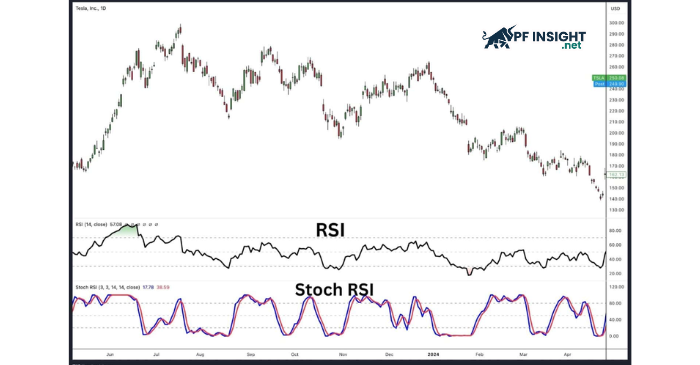
RSI vs Stoch RSI: Stochastic RSI reacts faster and generates more frequent signals than traditional RSI.
StochRSI is an “oscillator of an oscillator”
StochRSI is often described as an “oscillator of an oscillator” because:
RSI itself is already an oscillator
StochRSI applies the stochastic oscillator formula to RSI
Instead of measuring momentum directly from price, StochRSI measures where the current RSI stands relative to its RSI range (highest and lowest values within a lookback period). Normalizing RSI within this range makes the indicator significantly more sensitive.
It moves faster between overbought and oversold zones
Another key difference is:
RSI usually moves more slowly and rarely shifts quickly between extreme zones
StochRSI can swing very rapidly from overbought to oversold (or vice versa)
This happens because StochRSI does not only reflect whether RSI is rising or falling but also whether RSI is approaching the highest or lowest value within the lookback range. As a result, even a modest move in RSI within that range can cause StochRSI to change much more sharply.
More signals than RSI (and more potential noise)
Because of its high sensitivity, StochRSI often generates signals more frequently and reacts faster to momentum changes than traditional RSI. This is a major advantage during highly volatile market conditions, when traders need to detect early signs of reversals or momentum shifts. However, reference materials also emphasize that producing too many signals can become a “double-edged sword,” since StochRSI can fluctuate sharply and generate false signals if used on its own. Therefore, this indicator tends to work best as a supporting tool combined with other confirmation factors, rather than being treated as an absolute entry signal.
How to interpret StochRSI readings
To use StochRSI effectively, the key is not only watching whether the indicator is rising or falling but also understanding what its value zones mean and the market context surrounding them. Since StochRSI is designed to measure how “extreme” RSI is within a given period, it is especially useful for identifying overbought/oversold areas and short-term momentum shifts. However, traders should also remember that StochRSI signals appear frequently and quickly, so interpreting them correctly helps prevent rushed decisions.
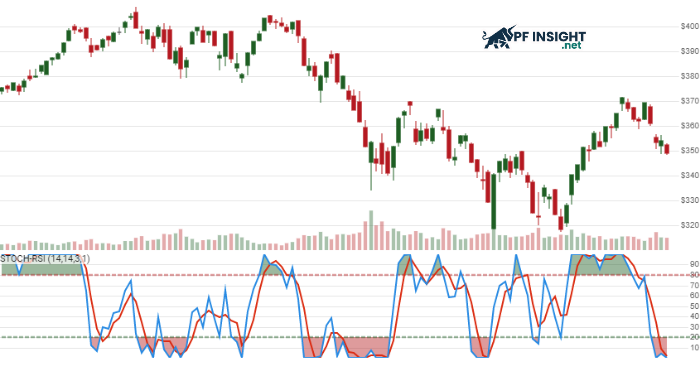
StochRSI on a price chart: overbought and oversold zones (80/20) and crossover signals.
Overbought and oversold levels (0.8 / 0.2)
In common usage, StochRSI oscillates between 0 and 1, where values:
Above 0.8 are typically considered overbought
Below 0.2 are typically considered oversold
The key point is: StochRSI does not mean the price will definitely reverse the moment it reaches 0.8 or 0.2. Instead, it indicates that RSI is at the highest or lowest end of its recent range, meaning the market is in an “extreme” momentum state. In practice, during strong trends, StochRSI can remain “stuck” in overbought or oversold zones for a period of time. Therefore, these levels should be treated as warning signals to monitor and wait for confirmation, rather than immediate buy/sell triggers.
The 0.5 midpoint and short-term trend context
Beyond identifying overbought/oversold zones, StochRSI can also be used as an oscillator with a midpoint at 0.5 to assess short-term trend bias. When StochRSI stays above 0.5, the market is often viewed as having a short-term bullish bias. When it remains below 0.5, short-term momentum may be leaning bearish. This approach is useful because it helps you go beyond extreme zones and place StochRSI within the trend context, reducing the likelihood of entering against the trend too early.
Common signals traders look for
In trading, StochRSI is typically monitored through two main signal groups: extreme-zone signals and momentum-shift signals. When StochRSI moves into the zone below 0.2 or above 0.8, it is often seen as a time to pay closer attention because the market may be approaching a correction or reversal phase. In addition, signals such as bouncing out of oversold territory or dropping out of overbought territory are widely watched, because they may reflect weakening momentum and a shift into a new market state. Some platforms also display StochRSI like a stochastic oscillator with signal lines, where crossovers can be used to increase confidence in identifying momentum changes.
How to make StochRSI more reliable
Because StochRSI is more sensitive and faster than RSI, signals appear more frequently, which also means the risk of noise is higher. To use StochRSI effectively, you should turn it into a clear checklist rather than treating it as an absolute buy/sell signal.
Rule 1: Use StochRSI as a warning tool, not a standalone trigger
When StochRSI enters overbought or oversold territory, treat it as a “warning light” that the market may be in an extreme momentum state. The key is not rushing into a trade just because it hits a threshold but waiting for confirmation from the broader context.
Rule 2: Reduce noise with smoothing
Because StochRSI can be highly volatile, traders often smooth it by applying a moving average to the StochRSI values. A common example is a 10-period SMA, which helps reduce whipsaws and improves signal stability.
Rule 3: Always confirm with another tool
StochRSI works better when combined with confirmation from other tools such as moving averages, MACD, Bollinger Bands, or chart patterns. This confirmation helps filter out false signals that often appear due to StochRSI’s high sensitivity.
Conclusion
Stochastic RSI can offer a strong edge by reacting quickly and helping you spot momentum shifts earlier in many market conditions. However, to reduce noise, it is best to smooth the indicator when needed and always use additional confirmation before making trading decisions. When applied within the right trend context and supported by solid risk management, Stochastic RSI can become a reliable part of your trading system. Thank you for reading this FP Insight article.