
Scalping trading strategies are suitable for traders who want to make quick profits by opening many orders in a short period of time. This method requires traders to understand the market structure, manage risks closely and maintain high discipline. In this article, PF Insight will analyze the best scalping strategies and important supporting tools to help traders improve their daily trading performance.
- Trend confirmation indicator MT4 features you must know before applying
- 5 Must-know quantitative trading strategies for consistent profits
- Best free Forex signal Telegram groups in 2025
What are scalping trading strategies?
Scalping trading strategies aim to take advantage of extremely small price fluctuations to generate continuous profits in a short period of time. This method is suitable for traders who like to trade quickly, with large volumes and do not want to wait for long-term trends.
To be effective, this strategy requires traders to understand how the market moves, choose the right time and react quickly to price fluctuations. Scalpers often rely on charts, price patterns and technical indicators to find high-probability short-term trading signals.
Characteristics of scalping trading

Scalping trading strategies have the following main characteristics:
- Small order size: Scalpers often open low volume orders to minimize risk when the market moves unexpectedly.
- Large trading volume: Scalpers execute orders continuously throughout the day, possibly dozens or hundreds of trades, to take advantage of every small market fluctuation.
- Extremely short holding time: Traders in this style only maintain positions for a very short time, sometimes only a few seconds to a few minutes before closing the order.
- Requires a high win rate: Since each trade only yields small profits, Scalping depends on maintaining a superior win rate for the final total profit to reach the desired level.
- Focus on technical signals: Scalpers often do not care about fundamental factors but mainly rely on price charts, patterns and technical indicators to find short-term entry points.
- Prioritize liquid markets: Scalping trading strategies work well in highly liquid markets with low bid-ask spreads, which helps reduce trading costs.
In general, scalping trading strategies focus on limiting risk by exploiting small price movements that occur continuously. Traders following this style need to maintain a stable win rate to ensure profits accumulate over many small trades.
Effective support tools for scalping trading strategies
To make a profit from scalping trading strategies, traders must be equipped with the right support tools to help identify and quickly take advantage of short-term opportunities that arise due to price fluctuations in the market.

Trading platforms
- Execution speed: Platforms like MetaTrader 4/5, cTrader or TradingView need to ensure low latency, helping orders to be matched quickly at target prices. This reduces the risk of Slippage, thereby protecting profits and improving efficiency when implementing scalping trading strategies.
- Interface & Features: The interface and features support quick order placement via One-Click Trading or shortcut keys, helping traders react promptly to price fluctuations.
Technical indicators
- Moving Averages: Moving averages come in two main types: SMA averages the price over a specified period of time, while EMA prioritizes the most recent data, helping traders quickly grasp price fluctuations and react promptly in scalping trading strategies.
- Bollinger Bands: This tool measures price volatility. It helps identify when an asset is too high (overbought) or too low (oversold) compared to its average price.
- Stochastic Oscillator: Measures the position of the closing price relative to recent price swings. This indicator fluctuates between 0 and 100, helping to identify extreme value zones. A reading above 80 confirms strong buying pressure (overbought), and a reading below 20 suggests strong weakness (oversold), which is useful for reversal signals.
- RSI (Relative Strength Index): An important momentum indicator that measures the speed and magnitude of price changes. Displayed as a number ranging from 0 to 100. A reading above 70 indicates an asset is overbought, while a reading below 30 indicates an oversold condition and a possible reversal.
Analysis tools
- Low timeframes: Scalping trading strategies require 1-minute (M1) and 5-minute (M5) candlestick charts. These are low timeframes to closely observe and react promptly to price action.
- VPS (Virtual Private Server): Scalpers often use VPS to maintain a stable, fast internet connection, limiting interruptions or delays in transactions.
- Drawing and price zone identification tools: Use tools like Support/Resistance and trendlines to quickly identify potential entry/exit points on M1/M5 charts.
Note: Scalping trading strategies are most effective when traders use only 2-3 indicators and understand how they interact with each other in a short time frame. Using too many indicators creates noise, slowing down reactions and trading decisions.
Comparison of scalping and day trading
Although scalping and day trading both involve completing trades within the same day, they differ significantly in strategy, execution, and the level of skill and risk management required.
Scalping trading: This strategy focuses on multiple orders during the day, each lasting only a few seconds to a few minutes, taking advantage of small price fluctuations to make a profit.
Day trading: Day trading involves holding orders for a few minutes to a few hours within the same day, taking advantage of larger price movements to maximize profits in a short time frame.
Understanding the differences between scalping and day trading helps traders choose the strategy that best suits their trading style, risk tolerance, and personal financial goals. The table below compares scalping and day trading to help you make the best choice.
| Scalping | Day trading | |
| Account type | Standard, ECN |
Standard, ECN |
|
Trading timeframe |
Seconds to minutes | Minutes to hours |
| Order execution speed | Executing trades in the hundreds daily. |
Trading volume is significantly lower, typically encompassing only 5-10 trades per day |
|
Investment scale |
Prioritizing minimal profits per transaction | Focusing on bigger movements, the goal is capturing significant price changes intraday |
| Risk | Elevated risk stems from the high transactional count and the dependence on very small gains. |
Risk level varies from moderate to high, contingent upon the specific execution strategy utilized. |
5 scalping strategies every trader should know
Scalping trading strategies take advantage of small and frequent price movements over short time frames. Each strategy has its own method of exploiting the market and maximizing profits. Below are some popular scalping strategies.
Scalping with Moving Average
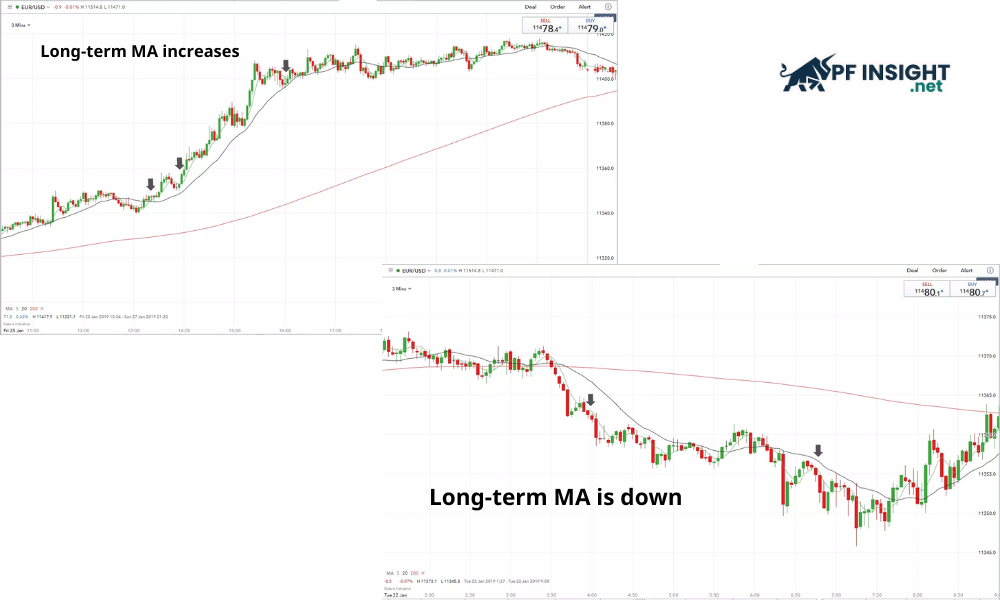
Another scalping trading strategy is to use moving averages, combining two short-term and one long-term line to determine the direction of the market trend. To understand better, let’s look at the EUR/USD M3 chart, set up with a 5-20-200 MA system.
Check MA 200: If it is rising, buy.
- Order entry rule: Wait for MA 5 (fast) to cross from bottom to top MA 20 (slow).
- This crossover event (indicated by the arrow) provides confirmation of the continuation of the bullish momentum, allowing traders to enter buy orders to profit from the main trend.
Check MA 200: If it falls, trade short.
- Order entry rules:The 5-period MA crossed below the 20-period MA, and shortly after, price broke below the 5-period MA, reinforcing the bearish momentum to enter.
Note: It is important to trade with the main trend, not to try to catch tops or bottoms. As with all scalping trading strategies, money management discipline is important. Always use a stop loss on every trade. This is an essential tool to protect your account from heavy losses.
Scalping with Parabolic SAR
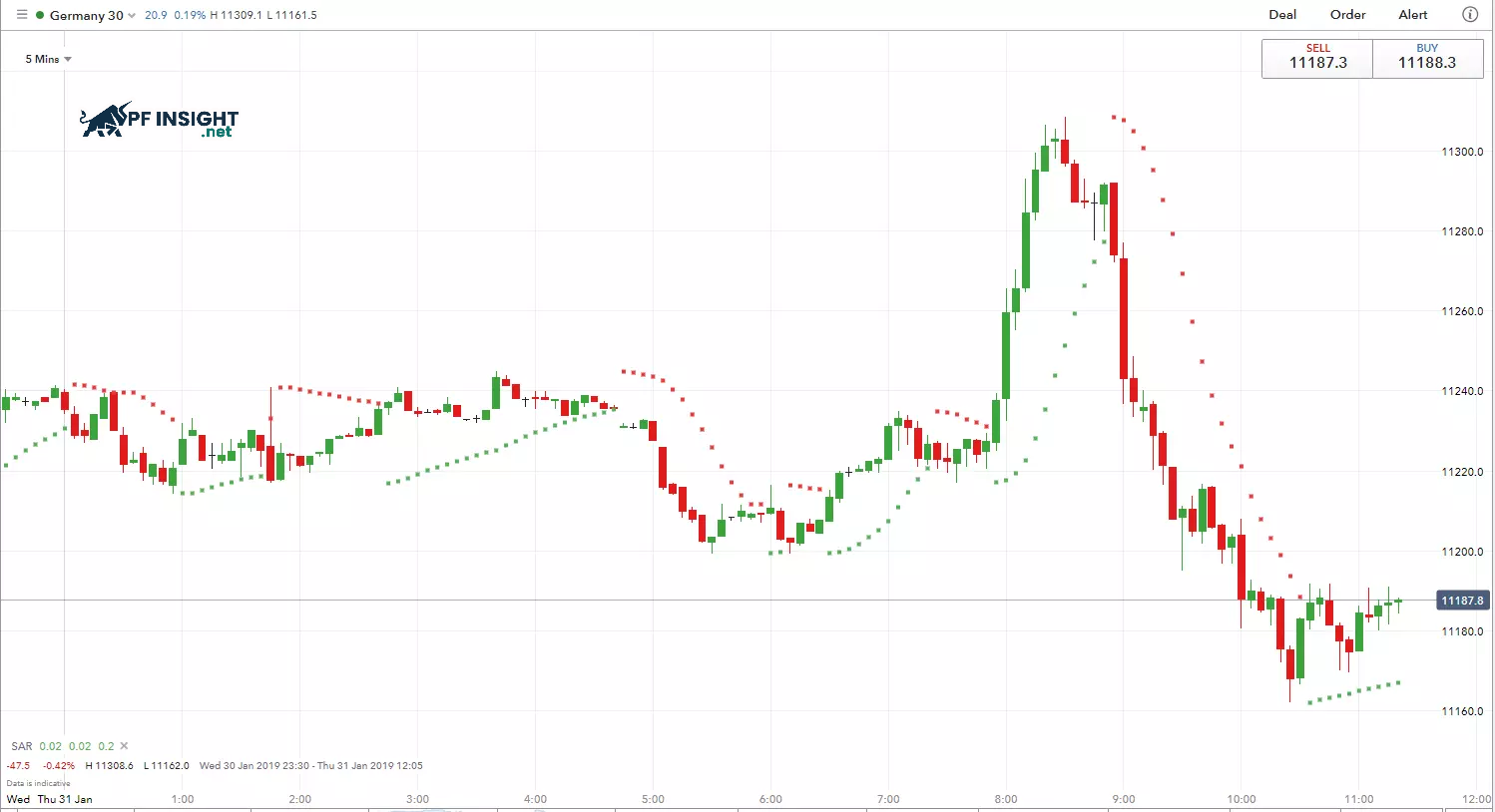
Parabolic SAR is a tool that helps determine the direction of the market and also suggests Stop and Reverse points. This indicator appears as a series of dots: Dots below the price bar indicate an uptrend (Bullish), while dots above the price bar indicate a downtrend (Bearish). This is a useful indicator for placing exit points.
The movement of the SAR dots is a sign of trend reversal or momentum. In the DAX M5 example, the trader enters a buy position when the price crosses the SAR dots and a sell position when the price falls below them. While the SAR can help take full advantage of long-term trends, it should be noted that this strategy is bound to be accompanied by many small losing trades (whiplash) when the market is not in a clear trend.
Scalping on multiple timeframes
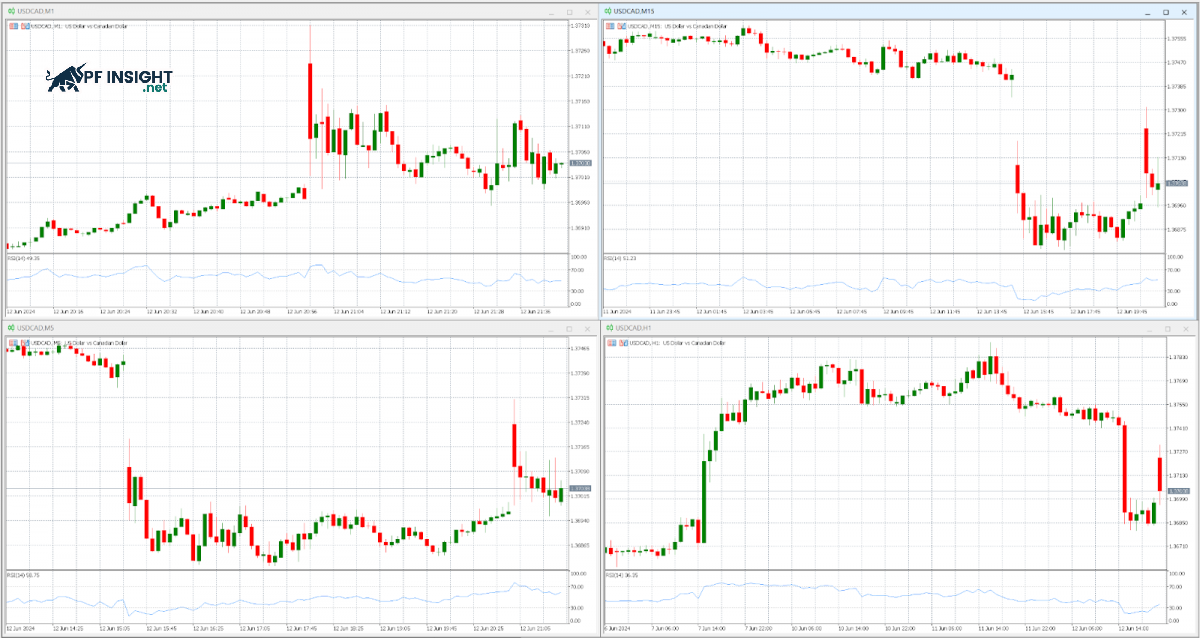
Multi-chart scalping uses multiple charts to improve trading decisions. By observing price action on larger time frames, traders can filter out false signals from smaller time frames. This scalping trading strategy helps confirm the main trend and execute trades with high accuracy.
To increase accuracy, scalpers should compare small timeframe charts (1 minute, 5 minutes) with larger timeframes (15 minutes, 1 hour). This helps to understand the market context. By only scalping when the short-term signal matches the trend identified on the long-term, the trader can limit risk and find the best entry and exit points.
For example: Set up 4 USD/CAD candlestick charts for 1 minute, 5 minutes, 15 minutes, and 1 hour time frames. Each chart is equipped with a blue 14-period RSI indicator below. Observing these time frames simultaneously helps the trader confirm the overall trend on the larger time frame, thereby increasing the reliability of entry signals on the smaller time frame.
Scalping with RSI indicator
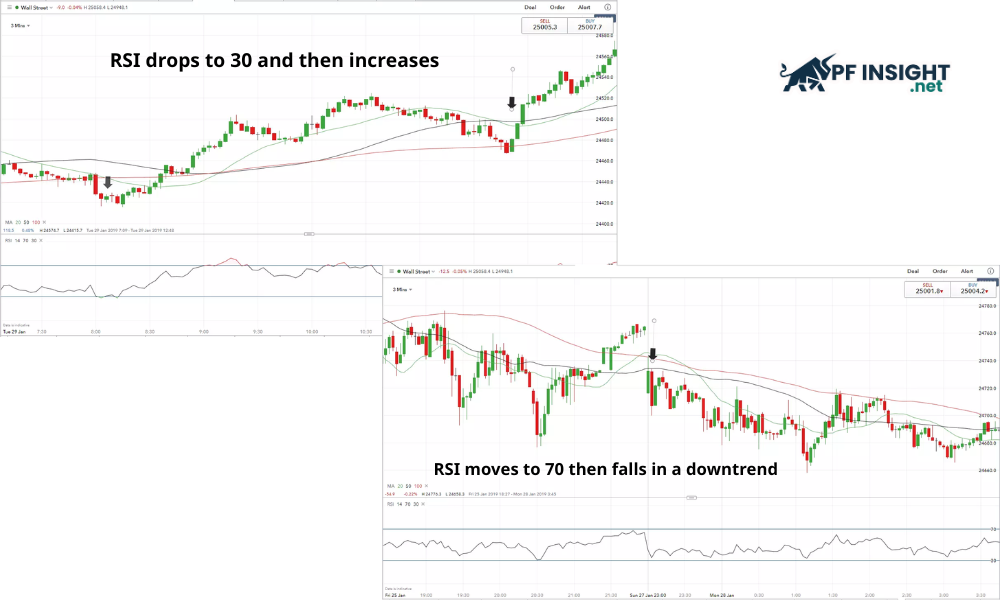
The Relative Strength Index (RSI) is a very popular momentum indicator that can be flexibly adjusted to many timeframes, including small ones. Scalpers use it to measure the speed of price changes, thereby determining effective entry and exit points in the current trend.
Looking at the chart shows a steady uptrend, confirmed by all three MAs pointing up. To find a buy point, wait for the price to retrace. When the RSI touches or below 30, signaling oversold, and then turns back above 30, it is a buy signal. Conversely, when the RSI touches 70 and starts to go down in a downtrend, it is an opportunity to look for an ideal sell position.
Scalping with Stochastic Oscillator
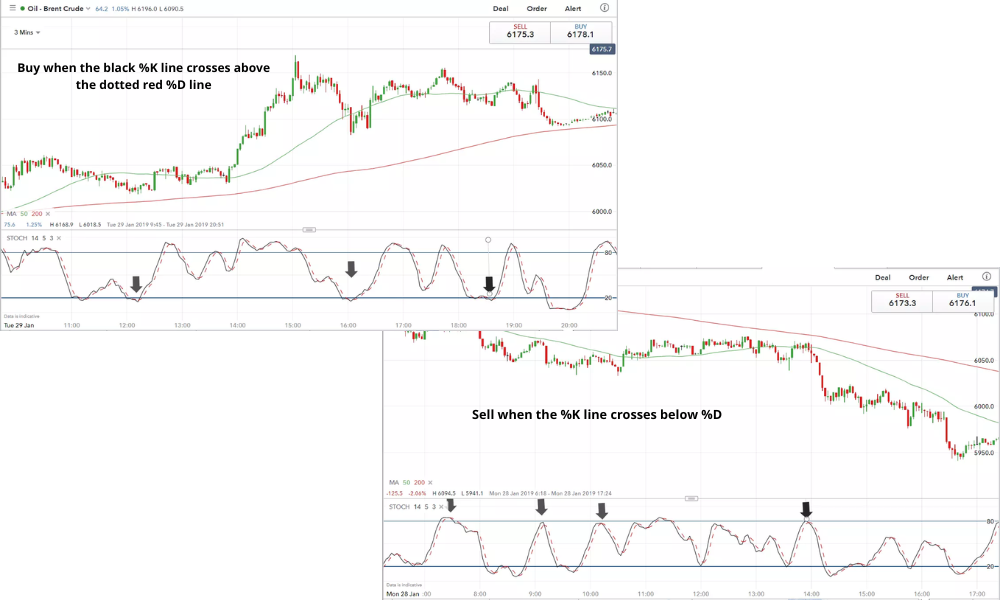
Scalping trading strategies can be effectively implemented using the Stochastic Oscillator. This indicator analyzes the position of the current closing price compared to the price range over the last period. By comparing this, the Stochastic attempts to identify overbought/oversold price points, thereby providing potential reversal signals to enter or exit a trade.
This oscillator is used by scalpers to look for opportunities in trending markets. Stochastic works because prices tend to stay near their most recent range points. When the indicator signals weakness at these points, it is a signal for the scalper to look for a short-term pullback in the direction of the main trend.
In the example of the Brent M3 chart with an uptrend, the trader looks for buy points at the oversold Stochastic zone. The lows on the indicator (indicated by arrows) are potential entry areas. The buy point is confirmed when the %K line crosses above the %D line. The trade should be closed when the indicator enters the 80 zone or higher, or when the %K line crosses below the %D line again, according to the risk management principles of scalping trading strategies.
Conversely, in a downtrend market, traders only look for short positions. The strategy is to “sell the rally”, not buy when the price falls.
Advantages and disadvantages of scalping trading
Scalping as a trading method requires investors to carefully consider its strengths and limitations. Understanding the pros and cons will help you make an informed decision about the viability of the strategy. Only when you find that scalping is suitable for your goals and risk tolerance should you apply it.
Advantage
- Provides the ability to make quick profits in a very short period of time.
- High trading volume helps to expand the profit levels that can be achieved.
- No overnight risk as all orders are closed the same day.
- No overnight or rollover fees.
- Easily apply automation to increase efficiency and reduce trading errors.
Disadvantages
- Scalping trading strategies require a high level of concentration and time commitment from the trader, unless using an automated system.
- Transaction costs increased sharply due to high order frequency.
- Great psychological pressure can easily make traders tired because of the fast trading speed.
- Traders need to continuously monitor the market and manage positions throughout the trading process.
- High risk of loss if wrong order is entered or incorrect transaction is executed.
Secrets to optimizing scalping trading strategies

If you are new to scalping trading strategies, here are a few important tips to help you get started right.
- Risk control: Scalping trading strategies involve extremely high trading frequency, which can lead to huge losses if the risk is not strictly controlled. To minimize this risk, placing a Stop Loss order on every trade is essential. At the same time, the trader must strictly follow a tested trading plan to ensure capital discipline.
- Capital conditions: To trade scalping effectively, maintaining a substantial capital is necessary to cover trading costs and frequent order entries. Although scalping in the online Forex market requires a lower initial capital compared to stock trading, you still need to ensure your account has enough funds to support high trading volumes.
- Mastering market knowledge: The sustained success of a scalper requires extensive knowledge of the market and its related technical indicators. Continuous learning is key to improving trading performance. Traders need to stay updated with the latest trends and market changes to optimize their strategies.
- Using technical tools: Applying fundamental technical analysis along with short-term momentum indicators is key to improving trading. They aid in signal filtering and make more effective scalping decisions.
- Choosing the right broker and platform: The success or failure of a scalper depends largely on using a fast, reliable platform from a broker that accepts this strategy. The minimum requirements for a platform are: real-time data, zero-latency execution, and full integration of indicators and charting tools necessary for short-term analysis.
- Prioritize trading in highly liquid markets: Prioritize markets with high liquidity and high trading volume. This ensures easy and fast order execution, minimizing slippage. Liquidity is the key factor for high-speed entry and exit of scalping trading strategies.
- Maintain discipline in trading: Stick to your strategy and never hold trades overnight. This helps focus on short-term, immediate profit opportunities, which is in line with the nature of scalping trading strategies.
Conclude
Scalping trading strategies require a commitment to strict risk management, especially the use of stop losses to protect capital from high-frequency trading. Before starting, traders should carefully evaluate whether the strategy is suitable for their personality, capital, and ability to focus.