Pullbacks often provide some of the most attractive risk-to-reward opportunities in trending markets, yet many traders enter too early and get caught in temporary reversals. The difference between a high-probability setup and a failed trade usually lies in confirmation. Pullback confirmation methods help traders distinguish between a healthy retracement and a potential trend reversal. Instead of reacting impulsively to price movement, experienced traders wait for structured validation before committing capital. In today’s article by PF Insight, we explore the most common confirmation techniques traders use across different markets. By understanding and applying these methods, you can improve entry precision and trade with greater consistency.
What is a pullback in trading?
A pullback is a temporary price movement against the prevailing trend. In an uptrend, it appears as a short-term decline. In a downtrend, it appears as a short-term rally. The key characteristic of a pullback is that the broader market structure remains intact.
Pullback vs retracement vs reversal
In practical trading, the terms “pullback” and “retracement” are often used interchangeably. Both describe temporary countertrend movement. A reversal, however, signals a structural shift in trend direction. The challenge traders face is identifying whether price is simply retracing within a trend or beginning a true reversal.
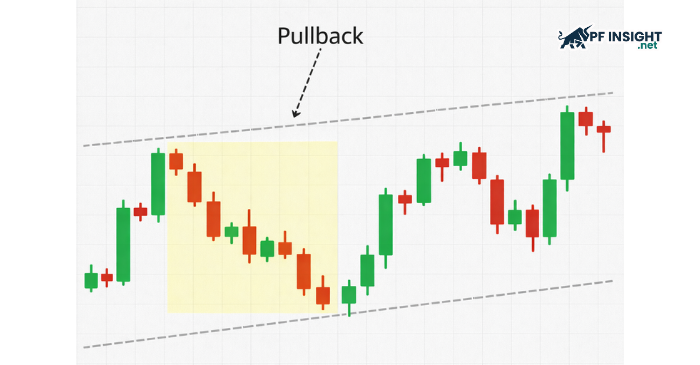
Figure: Example of a pullback within an overall uptrend channel.
Why pullbacks offer better risk-to-reward entries
Entering during a pullback allows traders to participate in the trend at more favorable prices. Stops can be placed logically beyond recent structure, and profit targets can align with trend continuation. This improves the risk-to-reward profile compared to chasing breakouts.
The role of trend structure
Trend structure provides the foundation for pullback trading. In an uptrend, higher highs and higher lows confirm bullish control. In a downtrend, lower highs and lower lows confirm bearish control. A pullback that respects this structure increases the probability of continuation.
Why confirmation matters before entering a pullback
Understanding pullbacks is not the same as trading them effectively. Many traders recognize a retracement within a trend but enter before the market shows clear signs that the pullback has actually ended. This premature entry is one of the most common execution mistakes in trend trading.
A major risk lies in false pullbacks. What initially appears to be a healthy retracement can quickly develop into a full trend reversal. Without confirmation, traders may commit capital in the middle of structural weakness rather than true continuation.
Liquidity dynamics add another layer of complexity. Markets frequently sweep recent highs or lows to trigger stop losses before resuming the primary trend. Traders who enter without confirmation often become part of that liquidity pool, getting stopped out just before the price moves in the anticipated direction.
Confirmation improves trade probability by adding objective validation to the setup. It does not eliminate risk, but it increases the statistical edge of the trade. By waiting for clear structural, price action, or momentum signals, traders reduce emotional decision-making and execute with greater consistency.
Common pullback confirmation methods traders use
Below are the most widely used confirmation techniques in technical analysis.
Support and resistance retests: One of the most reliable pullback confirmation methods involves horizontal support and resistance levels. When price breaks a key resistance level in an uptrend and later retests it as support, this retest can confirm continuation. The same logic applies in reverse during downtrends. Strong confirmation occurs when the level aligns with previous consolidation zones or breakout areas.
Trendline bounce confirmation: Trendlines help visualize dynamic support and resistance. During a pullback, price may retrace toward a rising trendline in an uptrend. A clear rejection from that trendline signals that buyers remain in control. However, traders should avoid relying solely on trendlines without additional confluence.
Moving average confluence: Moving averages such as the 20 EMA or 50 EMA often act as dynamic support in trending markets. When price pulls back toward a key moving average and shows bullish rejection, it provides confirmation of continuation. Confluence becomes stronger when moving averages align with horizontal levels or previous structure.
Fibonacci retracement levels: Fibonacci retracement tools help identify potential reaction zones within a trend. The 38.2 percent, 50 percent, and 61.8 percent levels are commonly watched by traders. When a pullback stalls at one of these levels and produces a clear price action signal, it increases the probability of continuation.
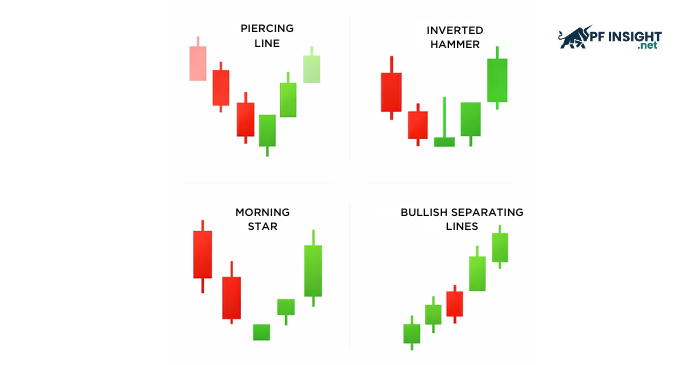
Price action confirmation signals: Candlestick patterns provide direct insight into order flow. Common confirmation signals include:
Pin bars with strong rejection wicks
Bullish or bearish engulfing candles
Inside bar breakouts following consolidation
These patterns indicate that momentum is returning in the direction of the trend.
Bullish candlestick patterns that traders use as pullback confirmation signals.
Volume confirmation: Volume analysis adds another layer of validation. In a healthy pullback, volume often decreases during retracement and expands during continuation. Rising volume on the breakout following a pullback suggests strong participation and reduces the likelihood of a false move.
RSI or momentum reset: In trending markets, RSI often resets toward neutral levels during pullbacks. In an uptrend, RSI may retrace toward 40 to 50 before turning higher. In a downtrend, it may retrace toward 50 to 60 before turning lower. This momentum reset can act as confirmation that the trend remains intact.
Combining multiple confirmation signals
Professional traders rarely rely on a single confirmation tool. Instead, they look for confluence, meaning multiple independent factors that support the same directional bias.
What confluence actually means
Confluence occurs when different types of analysis point to the same conclusion. Rather than stacking similar indicators, effective traders combine structural, technical, and momentum-based signals.
A strong pullback confirmation might include:
A retest of previous resistance acting as new support
Alignment with a key moving average such as the 50 EMA
A clear bullish engulfing candle at the reaction zone
Decreasing volume during the pullback followed by expansion on continuation
When these elements align, the setup carries greater statistical weight.
How many confirmation signals are enough?
There is no fixed rule, but most traders operate within a structured framework:
Two-signal confirmation: suitable for experienced traders who understand context
Three-signal confirmation: provides stronger validation in volatile markets
More than three signals: often leads to delayed entries and reduced reward potential
The goal is not to collect indicators but to improve probability without sacrificing timing.
Avoiding confirmation paralysis
Too much confirmation can become counterproductive. Adding excessive conditions may cause traders to hesitate or miss valid opportunities. Effective confirmation is about clarity, not complexity.
A practical approach is to define a simple checklist in advance. Once your predefined criteria are met, execution should be decisive and disciplined.
Common mistakes traders make when confirming pullbacks
Even with confirmation tools, execution errors can reduce effectiveness.
Entering before the pullback completes: Impatience leads traders to enter during active retracement rather than after confirmation appears.
Ignoring higher timeframe context: A pullback on a lower timeframe may actually be a reversal on a higher timeframe. Always align entries with broader market structure.
Relying on a single indicator: Indicators should support price action, not replace it. Overreliance on one tool increases vulnerability to false signals.
Conclusion
Pullbacks create opportunity, but only when approached with structure and discipline. Pullback confirmation methods help traders filter noise, reduce false entries, and align with prevailing market trends. No single confirmation tool guarantees success, but combining structure, price action, and momentum significantly improves probability. The key is consistency in execution and disciplined risk management. By applying these principles, traders can approach pullback entries with greater confidence and long-term sustainability.
We wish you successful trading, and be sure to explore more in-depth trading insights at Technical Analysis.