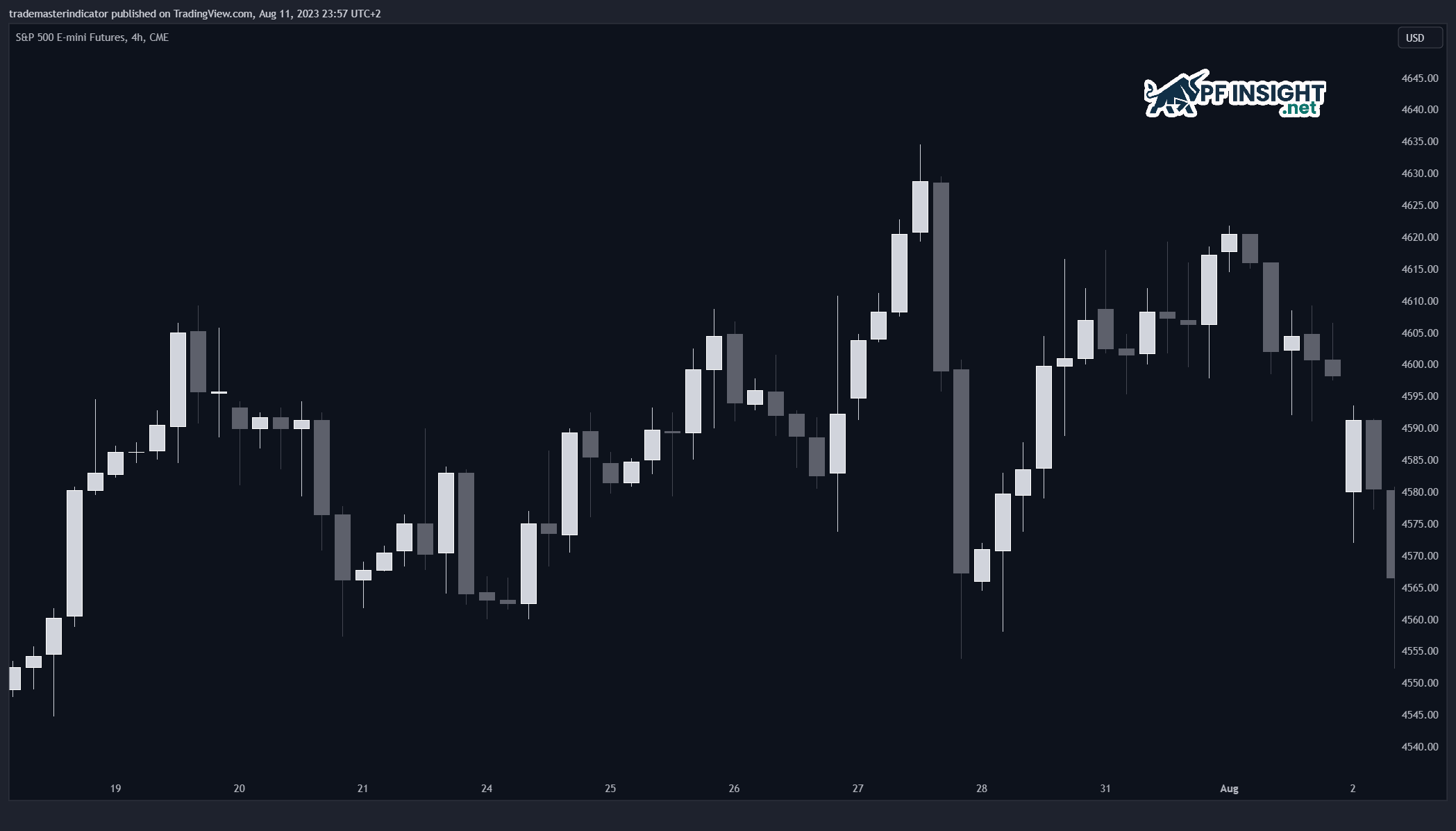
In finance, the efficient market theory posits that prices always accurately reflect value. However, reality is quite different. Price inefficiency in trading refers to moments of imbalance between supply and demand, creating liquidity gaps on the chart. Understanding the nature of this phenomenon not only helps you understand the behavior of large financial institutions but also opens up trading opportunities with low risk and breakthrough profits.
Price inefficiency, also known as imbalance, occurs when the balance between supply and demand in the market is disrupted. During these times, orders are no longer matched evenly at each price level, with either buyers or sellers dominating. As a result, prices move very quickly, creating inefficient zones that the market often retests later.
Key factors that create price inefficiency in financial markets
Price inefficiency in trading doesn’t occur randomly. It arises from the intense clash between large capital flows, market information, and traders’ psychological reactions, causing a short-term imbalance between supply and demand.
Key factors that create price inefficiency in financial markets
Information asymmetry
In an ideal market, everyone receives information at the same time. But in reality, information flows like a delayed stream:
News arrives late or is misinterpreted: When an economic report (such as the Fed interest rate) is released, algorithms (algo-trading) react in milliseconds, while individual traders take several minutes to read and understand. This delay creates sudden price gaps before the majority can react.
Insider Information: Individuals holding confidential information often act before the news becomes public. This creates “unusual” price fluctuations on charts without clear reason, leaving imbalances due to silent accumulation or dumping.
Trading psychology
Whether trading manually or with robots, every final decision still reflects human psychology. When emotions dominate buying and selling behavior, the market easily falls into a state of imbalance, thereby creating price inefficiency in trading.
Fear & Greed: Greed and the fear of missing out cause buyers to accept high prices, driving prices far above their true value in a short period of time.
Fear: When bad news arrives, panic causes people to sell off indiscriminately, creating “Liquidity Void” areas because no one dares to step in and buy.
Herd Mentality: Traders tend to mimic the actions of the majority. When a large group buys or sells at the same time, they inadvertently create a strong one-way price movement, disrupting the natural equilibrium structure of the market.
Big orders from the organization (Big Boys)
Large institutional orders (Big Boys) are one of the key causes of price distortions in the market. When large banks, investment funds, or financial institutions enter transactions, they often place orders with very large volumes, far exceeding the current liquidity’s absorption capacity. Because it’s impossible to match all orders at a single price, these orders wipe out pending buy or sell orders at multiple consecutive price levels.
As a result, prices are pushed up very quickly in a short period of time, creating candlesticks with long bodies, few wicks, or price gaps appearing on the chart.
This phenomenon causes prices to temporarily not accurately reflect true supply and demand, as price movements are primarily driven by the order matching needs of large institutions rather than the behavior of the majority of the market.
After the accumulation or distribution process by the “Big Boys” ends, prices tend to correct or return to their previous liquidity zones. This is precisely when many individual traders identify price inefficiency to look for trading opportunities.
How to identify price inefficiency in the market
Price inefficiency in trading is a sign that supply and demand are no longer balanced at a given time, often occurring when large amounts of money enter the market. To identify price inefficiency, you can rely on the following characteristics:
How to identify price inefficiency in the market
Identifying through Fair Value Gap (FVG)
Fair Value Gap (FVG) is one of the most important indicators for identifying price inefficiency in the SMC/ICT method. An FVG forms when the price moves too quickly in a series of three consecutive candlesticks, preventing the order execution process from being complete.
Specifically, the FVG zone appears when the lowest price of the first candlestick does not intersect with the highest price of the third candlestick. This indicates that the middle candlestick created a strong push, giving either buyers or sellers absolute dominance. That empty price range is the imbalance zone, where the market often tends to return to rebalance.
Volume (Trading volume)
In real-world trading, price inefficiency becomes much more reliable when confirmed by trading volume. A typical indicator is the appearance of candlesticks with long bodies, large price ranges, and an unusually sharp increase in volume. When impulse candlesticks are accompanied by high volume, this indicates that large amounts of institutional money are actively involved and sweeping through liquidity, creating a significant imbalance.
Conversely, if the price moves sharply but the volume is low, this is usually a consequence of a temporary lack of liquidity. These types of inefficiency zones are unsustainable and are often quickly broken through by the price in subsequent movements.
Liquidity void
Liquidity void is a form of price inefficiency in trading that is larger in scale than a typical Fair Value Gap. This phenomenon often occurs when the market reacts strongly to major events such as CPI, unexpected news, or widespread FOMO (Fear of Missing Out).
On a chart, a liquidity void is represented by a series of candlesticks with very long bodies, moving continuously in one direction with very few wicks or corrective movements. This indicates a lack of counterforce at intermediate price levels, causing prices to “rush” through a wide area without balanced two-way trading. These gaps often become important price zones when the market returns to rebalance in the future.
Trading strategies using price inefficiency
Price Inefficiency trading strategies focus on exploiting price zones where the market has moved too quickly due to supply-demand imbalances, often leaving liquidity gaps.
Trading strategies using price inefficiency
Entry when price returns to fill the Inefficiency
Entering when the price reverses to fill inefficiency is a strategy favored by many professional traders because it closely follows the behavior of large money flows.
After a sharp market move, the inefficiency zone often acts as a “price magnet,” attracting the price back to balance supply and demand. When the price retraces to 50–100% of the inefficiency zone in line with the HTF trend, the probability of a price reaction is very high, allowing traders to enter trades with short stop losses and attractive risk-reward ratios (R:R).
Entry: In an uptrend, it’s preferable to wait for the price to retrace to the bullish inefficiency zone before executing a Buy order in the main trend. Conversely, when the market is in a downtrend, traders should look for Sell opportunities in the bearish inefficiency zone to take advantage of the continued selling pressure.
Stop Loss: Place your stop loss outside the inefficiency zone to avoid price noise: For buy orders, place it below the bottom of the zone; for sell orders, place it above the top of the zone.
Take Profit: The profit-taking target can be the nearest peak or trough, or further afield, liquidity zones such as equal highs/equal lows, where prices often react strongly.
Inefficiency combined with market structure
This strategy helps traders filter out a lot of noise in the market. When the price breaks out of the old structure (BOS) or a structural change (CHoCH) occurs, it indicates that large amounts of money have entered the market and created an inefficiency zone. If this zone also aligns with the HTF trend, the probability of a successful trade is significantly higher, as the order is placed based on both price behavior and market structure, rather than just a single signal.
Entry: When the price retraces to the inefficiency zone in line with the HTF trend, switch to LTF (M5–M15) and enter the trade when a confirmation signal appears, such as a reversal candlestick, a small structure breakout, or clear rejection.
Stop Loss: Place it outside the inefficiency zone, below the bottom of the zone for Buy orders and above the top of the zone for Sell orders to limit risk.
Take Profit: Prioritize the nearest peaks/troughs, liquidity zones (equal high/low), or longer-term targets based on market structure to optimize the Risk-Reward ratio (R:R).
Inefficiency at the Premium/Discount zone
This strategy focuses on optimizing entry points in the context of price inefficiency in trading. When an inefficiency zone forms and is simultaneously within a Premium zone (for Sell) or Discount zone (for Buy), the probability of a strong price reaction is higher. This helps traders avoid chasing or selling prematurely, while significantly improving the risk-reward ratio (R:R), especially effective when combined with HTF trends and market structure.
Entry: Use Fibonacci to determine the Premium/Discount. In an uptrend, wait for the price to retrace to a bullish inefficiency zone within the Discount (0.5 – 0.79) and then look for a confirmation signal on the Long-Term Finite Average (LTF) to Buy. Conversely, in a downtrend, Sell at a bearish inefficiency zone within the Premium.
Stop Loss: Place it outside the inefficiency zone to avoid noise sweeps. Buy at the bottom of the zone, Sell at the top of the zone.
Take Profit: The profit target is the top/bottom of the structure, liquidity zones (equal high/low), or trend extension to achieve a high R:R ratio.
Important considerations when trading price efficiency
Trading with price inefficiency offers a significant advantage in terms of risk/reward ratio, but without caution, it’s easy to fall into the trap of “catching a falling knife”.
Important considerations when trading price efficiency
Not every price gap will be filled immediately
A common mistake among new traders is assuming that any price gap will inevitably lead to a rebound. In reality, even when the market tends to balance supply and demand, there’s no rule that dictates the price must immediately reverse. In strong trends, inefficiency zones can remain open for a long time, even weeks or months. Therefore, attempting to enter a trade against the trend based solely on inefficiency is extremely risky.
Focus on Inefficiency on higher timeframes
In fact, the effectiveness of inefficiency increases progressively across timeframes. On smaller timeframes like M1 or M5, many price gaps only reflect short-term noise or immediate liquidity shortages, easily leading to order traps. Conversely, on larger timeframes like H4, D1, or W1, inefficiency is often formed by large capital flows from banks and funds, so when the price reverses, the reaction is usually strong, clear, and creates more stable long-term trends.
The 50% rule – price equilibrium zone
When the market corrects back to a price imbalance zone like FVG, the 50% mark of this zone, also known as the Consequent Encroachment, often acts as a key support or resistance point.
If the candlestick price significantly breaks above the 50% mark, there’s a high probability the market will continue to move to fill the entire inefficiency zone. Conversely, if the price only approaches the 50% mark before being strongly rejected and retracing, it reflects that the initial trend momentum remains clearly dominant.
Avoiding the empty liquidity trap
Avoiding the empty liquidity trap is a crucial element in price inefficiency trading, helping traders avoid being caught in price swings where there isn’t real cash flow.
Areas with low liquidity often cause prices to move very quickly but unsustainably, easily creating traps for early entry. Therefore, traders need to combine market structure analysis, HTF trends, and price behavior to identify movements driven by institutional money flows, thereby limiting risk and increasing the probability of successful trades.
Trades must align with clear market structure
Analyzing market structure in parallel is a core principle of price inefficiency in trading, helping traders avoid emotional trading. When an inefficiency zone appears, checking whether it aligns with the BOS, CHOCH, and HTF trends will determine the reliability of the signal. This combination effectively filters noise, correctly identifies the market context, and increases the probability of success for each trade.
Conclude
In reality, price inefficiency in trading reflects the true behavior of the market, where large institutions leave their mark through sharp price movements. Instead of trading emotionally, traders should learn to read imbalances, wait for price reversals, and only enter trades when market conditions are favorable. According to PF Insight, patience and discipline in trading will significantly improve long-term performance.