

In Forex trading, understanding how currency pairs work is a fundamental step to help traders analyze the market more accurately. Each currency pair represents the relative strength of two currencies, thereby reflecting the economic trends of each country. When you master this operating mechanism, you will easily determine the time to enter orders, manage risks and optimize effective trading strategies.
- Trading indices for beginners: key concepts and how index trading works
- Is MT4 safe to use and what traders should check before installing
- What is MT4 in trading and why it remains the top choice for forex traders
What are currency pairs?
A currency pair represents the exchange rate between two currencies, indicating the value of one currency in terms of the other. In each pair, the first currency is considered the base currency, which acts as a standard. The second currency is the quote currency, which indicates how many units are needed to exchange for one unit of the base currency.
Currencies in the international market are identified through three-letter ISO codes, which help standardize and differentiate each currency in all global transactions.
For example, if the GBP/USD rate is quoted at 1.25, this means that one British pound is worth 1.25 US dollars. In this pair, GBP is the base currency and USD is the quoted currency. So, 1 British pound is worth 1.25 US dollars.
How currency pairs work?

When you open a buy order on a currency pair, you are exchanging the base currency for the quote currency. When you open a sell order, the process is reversed: you sell the base currency and receive an equal amount of the quote currency.
Let’s say the USD/JPY currency pair is priced at 110.20/110.40. 110.20 is the sell price and 110.40 is the buy price. If you want to buy 1 USD, you have to pay 110.40 JPY. Conversely, if you sell USD, you will receive 110.20 JPY.
If you believe the USD will appreciate against the JPY, you can open a long position on the USD/JPY pair to benefit from this trend. Buying indicates an expectation of a stronger USD. Conversely, if you expect the USD to depreciate and the JPY to rally, you should open a short position.
How to read currency pair rates
In Forex trading, each currency pair has a buy price and a sell price. Knowing how currency pairs work helps traders understand the mechanism: buying the base currency at the sell price and selling at the buy price, thereby making more accurate trading decisions.
- Bid price: Also known as buying price, is the price a broker is willing to pay to receive a certain currency or asset.
- Ask price: also known as offer price, is the price a trader is willing to receive to exchange a certain currency or asset.
- Spread: The difference between the buy and sell price of a currency pair.
For example, consider the EUR/JPY pair. Let’s say you want to exchange EUR for JPY. The exchange rate is 130.0/131.0, meaning 1 euro can be exchanged for 130 yen if sold and 131 yen if bought. In this case, EUR is the base currency and JPY is the quoted currency.
When the EUR/JPY rate is 130.0/131.0, a price of 131.0 JPY shows that you need to pay that much to buy 1 EUR. Conversely, if you sell EUR, you will receive 130.0 JPY for each euro.
Classification of currency pairs in Forex
Currency pairs are divided into major, minor and exotic.
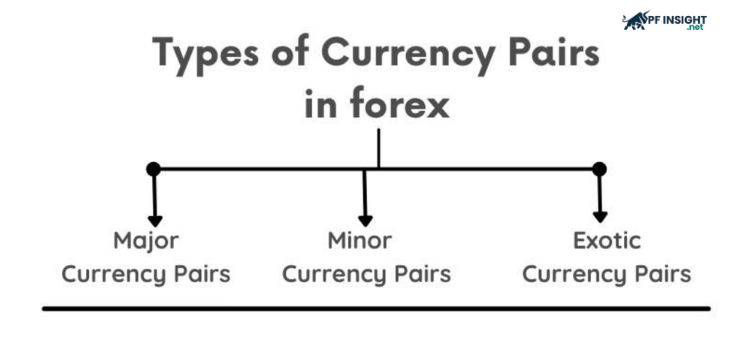
Major currency pairs
In Forex, there are seven major currency pairs, all involving the USD. They are widely traded due to their high liquidity and stable volatility.
- EUR/USD: Euro/US Dollar
- GBP/USD: British Pound (sterling)/US Dollar
- USD/JPY: US Dollar/Japanese Yen
- USD/CHF: US Dollar/Swiss Franc
- NZD/USD: New Zealand Dollar/US Dollar
- USD/CAD: Canadian Dollar/US Dollar
- USD/AUD: Australian Dollar/US Dollar
Currency pairs are characterized by high liquidity, which results in the narrowest spreads. The huge trading volume ensures that there is always someone willing to buy or sell, minimizing slippage. This allows traders to execute trades at lower costs and with greater accuracy than with less traded pairs.
The most traded currency pairs represent the major economies. This huge trading volume ensures high liquidity, which keeps the spread between the bid and ask prices very small.
- EUR/USD – Euro/US Dollar
- USD/JPY – US Dollar/Yen
- GBP/USD – British Pound/Dollar
- USD/CHF – Dollar/Swiss Franc
Note: EUR/USD is the most widely traded currency pair globally, reflecting the value of the euro and the US dollar, representing the economies of the European Union and the United States.
Minor currencies and minor currency pairs
Currency pairs that do not include the US Dollar (USD) are called minor pairs or cross pairs. The most traded cross pairs usually incorporate other major currencies, such as EUR/JPY or GBP/CHF. While they still have good liquidity, they are generally not as liquid as major pairs that include the USD.
- EUR/GBP – Euro/British Pound
- EUR/CHF – Euro/Swiss Franc
- EUR/JPY – Euro/Japanese Yen
- GBP/JPY – British Pound/Japanese Yen
- CHF/JPY – Swiss Franc/Japanese Yen
- AUD/JPY – Australian Dollar/Japanese Yen
- CAD/JPY – Canadian Dollar/Japanese Yen
Exotic currencies and exotic currency pairs
Trading exotic currency pairs (usually emerging market currencies) is riskier. They are the least liquid on Forex. This low trading volume results in extremely wide spreads, which affects trading costs.
Exotic currency pairs in the Forex market are formed when one of the major currencies (USD, EUR, GBP, JPY) is traded against a less liquid currency. A typical example is EUR/ZAR (Euro/South African Rand). Like the major pairs, they have a base and quote currency structure to determine their value. However, their limited trading volume makes them more volatile than the major pairs.
- EUR/TRY – Euro/Turkish Lira
- USD/TRY – US Dollar/Turkish Lira
- USD/MXN – US Dollar/Mexican Peso
- USD/ZAR – US Dollar/South African Rand
- USD/HKD – US Dollar/Hong Kong Dollar
- USD/SGD – US Dollar/Singapore Dollar
- USD/THB – US Dollar/Thai Baht
What affects the exchange rates of currency pairs?

Currency pairs reflect the complex interactions between economies and world events. Understanding how currency pairs work allows traders to assess the impact of these factors, thereby improving their trading strategies and increasing their profitability.
- Economic reports: Economic reports are a key factor in determining the value of a currency. Indicators such as GDP growth and inflation figures have the potential to cause large movements in currency pairs. For example, when the Eurozone reports better-than-expected GDP, the EUR can appreciate strongly against other currencies, such as the EUR/USD pair. This reflects the market’s confidence and positive expectations about the economic health of that region.
- Interest rates: The interest rate policy of a Central Bank has a direct impact on the value of a currency. If a Central Bank reduces interest rates, the currency of that country tends to weaken. Lower yields reduce the attractiveness of the currency and related assets to international investors. This lack of attractiveness causes capital outflows, putting downward pressure on the value of that currency. Therefore, interest rate decisions are a core factor in shaping currency pairs.
- Political, social: Geopolitical stability is a key factor influencing currency values. Events such as military conflicts or major political tensions can cause strong fluctuations. For example, a geopolitical crisis in Europe can cause the EUR to weaken significantly against the JPY in the EUR/JPY pair, reflecting capital flows into safer assets.
- Market sentiment: Market sentiment is shaped by how traders interpret and react to news. This perception often causes immediate but temporary price movements. An unexpected economic forecast can trigger a wave of panic buying or selling, causing sudden changes in the exchange rates of currency pairs. This expectation-based psychology fuels speculative behavior, causing prices to fluctuate wildly before stabilizing.
- Natural disasters, pandemics: Natural disasters or pandemics often cause rapid and unpredictable market reactions. They change a country’s economic outlook, such as reconstruction costs or supply chain disruptions, which immediately reduce confidence and affect the strength of currencies and exchange rates globally.
By understanding the factors that affect the market, traders can better manage orders and predict prices. Understanding currency pairs help to take advantage of the volatile yet opportunistic nature of the Forex market more effectively.
Basic guide to trading Forex currency pairs
Once you understand how currency pairs work, you can trade currency pairs more intelligently, predict price movements accurately, and manage risk effectively. Here are the steps to get started with currency pairs in Forex:

Step 1:Open a Forex account
To trade Forex, the first step is to open an account with a regulated broker. Consider a broker with low spreads to reduce costs. Additionally, fast withdrawals, competitive leverage, and ongoing customer support are key to optimizing your trading experience.
Step 2: Make a trading plan
Any Forex trader needs a detailed trading strategy, defining goals and execution rules. This strategy acts as a powerful support tool for transactions. By setting clear rules on when to enter/exit orders, it helps traders eliminate subjectivity and work towards achieving long-term trading goals.
Step 3: Choose the right currency pair
There are hundreds of different currency pairs you can trade, but it is important to be selective. Look for pairs that are highly stable and that correlate well with your strategy. This will help you focus your resources and avoid wasting time on pairs that are too volatile or do not fit your trading plan.
Step 4: Open trading position
To start trading, you need to place a Buy or Sell order on the selected currency pair. This process involves specifying the volume (number of units) you want to trade. Once you confirm the order, the Forex broker will process and match it. Funds will be temporarily deducted from your balance to secure the position. This confirms that you have received the corresponding Forex volume, and the profit/loss will start to be calculated based on the price movement.
Step 5: Transaction Management
After your first trade, you need to keep a close eye on the currency pair and the overall Forex market. The goal is to look for emerging trends. These trends are key to helping you determine the ideal price point to close your position (exit the market) or strategically consider opening more positions (re-enter the market).
Step 6: Exit the command when necessary
Once you have reached your target profit or you notice that the market is starting to move against you, it is time to close your position. You need to inform the broker how much or how much you want to close. Once the broker executes your order, the money will be deducted from your trading account along with the profit or minus the loss. The final payment will be transferred to your bank account.
Important notes when trading currency pairs

When trading currency pairs, it is important to understand how currency pairs work. Understanding how each currency pair reacts to market fluctuations helps traders make informed decisions, manage risk effectively, and optimize profits in the volatile Forex environment.
- Before investing in a currency pair, do a deep analysis of the economy involved. Consider factors such as political stability, financial situation and overall economic health to make safe and effective trading decisions.
- Traders should evaluate a currency pair based on its volatility, liquidity, and average daily trading volume to ensure the choice fits their strategy.
- Build a diverse portfolio by including major, minor and even exotic currency pairs in your trading strategy.
- Traders should stay calm and not let emotions control them. Focus on analyzing charts, technical indicators and market data to make accurate trading decisions.
- For new traders, it is advisable to start with a single order and monitor it closely, instead of opening multiple orders at the same time, to reduce risk and easily learn how the market works.
- Setting and adhering to tight stop-loss levels helps protect capital from potential losses during periods of high market volatility or economic crises.
- Always monitor market movements closely to determine the right time to enter or exit forex positions, helping to optimize profits and minimize risks.
- Applying leverage in Forex allows you to enter the market with a small amount of capital but control a larger position, thereby maximizing profits without investing too much initial capital.
- Combine multiple technical indicators to validate price analysis, and only execute trades when signals from multiple indicators confirm the trend.
- Closely following economic and financial news helps you keep up with market fluctuations, thereby making more effective decisions about trading currency pairs.
Conclude
To trade Forex successfully, it is important to understand how currency pairs work. According to PF Insight, when you understand the mechanism of operation and the factors that affect prices, you will easily predict fluctuations, choose the right strategy and manage risks well, thereby maximizing profits and building a sustainable trading platform.