As markets move faster and price data becomes increasingly complex for traders to process manually, an automated trading system helps execute trades with greater accuracy, discipline and consistency. By automating the decision-making process, traders can minimize emotional influence and maintain strict adherence to their strategy across all market conditions. From basic algorithmic rules to more advanced quantitative models, automated trading systems are reshaping the way both retail and institutional traders approach the markets.
Today, let’s take a closer look with PF Insight at what automated trading systems really are and how they operate behind the scenes.
- How to create an MT4 trading system that actually performs in live markets
- What are EA trading rules? The ultimate guide to effective automated trading
- Manual trading explained: advantages, risks, and when to use it
What is an automated trading system?
An automated trading system (ATS) is a software-based mechanism that executes trades in financial markets such as forex, stocks, crypto or commodities based entirely on predefined rules. The system can monitor price movements, analyze market data, identify trading signals, open and close positions and even manage risk without any manual intervention from the trader.
In other words, an ATS functions as a fully automated trading engine that handles the entire workflow: monitors and analyzes price action, triggers buy or sell signals based on programmed logic, executes orders at high speed, sets stop loss, take profit and position size, oversees trades around the clock.
Because it operates on algorithms, an ATS processes information and reacts far faster than a human, especially in fast-moving markets. This helps traders avoid missed opportunities, reduce emotional decision-making and maintain consistent discipline throughout their trading strategy.
How automated trading systems work
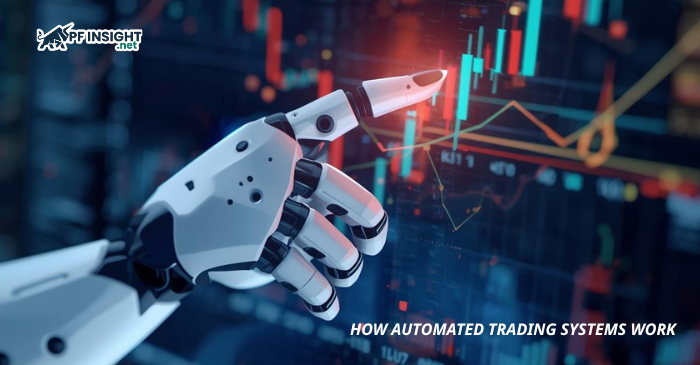
An automated trading system operates by using programmed algorithms that continuously scan the market for trading opportunities based on predefined conditions. The system analyzes real-time price data, technical signals and volatility patterns to identify suitable setups. When the market presents a condition that matches the rules of the strategy, the system automatically sends an order without any manual intervention. After the trade is executed, the system continues to monitor its progress, adjusting or closing the position when risk-management criteria or profit targets are met.
At the core of this entire process are the underlying algorithms and the software that runs them. These algorithms process large volumes of data at high speed and make decisions strictly according to the programmed logic, without emotional influence. The software connects directly to the trading platform and the broker, ensuring that all signals and trade executions are handled smoothly, consistently and accurately.
To interact with the market, the system uses the API provided by trading platforms, allowing it to receive real-time price feeds, transmit orders and update trade status instantly. This seamless connection enables the system to execute orders at very high speeds, minimizing latency and optimizing performance especially valuable in fast-moving markets such as forex and crypto.
Key benefits of automated trading systems

Automated trading systems offer several advantages that help traders execute with greater accuracy, maintain discipline and overcome the limitations of manual trading.
- Emotion-free execution: Automated systems remove psychological factors such as fear, greed and FOMO. Every decision is made strictly according to predefined rules and algorithms, allowing traders to maintain long-term consistency.
- Superior execution speed: Within just a few milliseconds, the system can analyze the market and send an order. This speed is essential for capturing fast-moving opportunities, especially in forex, crypto and index markets where timing is critical.
- Perfect trading discipline: There are no impulsive entries, no moving stop losses and no closing trades too early. An automated system follows the strategy exactly as programmed, even during periods of high volatility.
- Accurate backtesting and strategy optimization: Traders can test strategies on historical data to evaluate performance, refine parameters and eliminate weaknesses before going live. This reduces trial-and-error and improves long-term system reliability.
- Continuous trading across multiple markets: An automated system can operate 24/7, monitoring dozens of pairs or assets simultaneously without the trader being present. This expands the number of potential opportunities and significantly reduces manual workload.
Challenges and risks every trader should know
Although automated trading systems provide accuracy, discipline and superior execution speed, they also come with several challenges that traders often underestimate. Understanding these risks is essential before allowing an automated system to trade on your behalf.
Reliance on the quality of the algorithm
An automated system is only as good as the strategy behind it. If the underlying logic contains flaws, unreliable signals or incorrect market assumptions, the system will replicate those mistakes across dozens of trades. Unlike humans, the system cannot “sense” risk and will continue executing faulty logic until the account is significantly damaged. This is why thorough strategy validation is mandatory before automation.
Technical risks and unpredictable software failures
Automation depends entirely on technology: internet connectivity, VPS stability, servers, broker APIs and trading platforms. A small issue such as latency, a brief disconnection or a frozen EA can cause missed entries, wrong prices or failed exits. In fast-moving markets, these technical failures can lead to substantial losses even when the strategy itself is correct. Every trader using bots or EAs eventually encounters these risks.
Over-optimization in backtesting
One of the biggest pitfalls in automated trading is curve fitting: over-optimizing the strategy so it fits historical data perfectly. Backtests may show high win rates and smooth equity curves, but real-time results often collapse. The system performs well on past data but cannot adapt to live market behavior. This is one of the most common reasons traders place misplaced confidence in their automated systems.
Limited ability to adapt to sudden market shifts
Automated systems operate on fixed rules. Real markets, however, change constantly: unexpected news, liquidity drops, sharp volatility spikes or rapid trend reversals. Without logic designed to handle exceptional conditions, the system may continue trading as if nothing has changed, leading to consecutive losses. Human discretion can stop trading when conditions are abnormal, whereas bots cannot.
Operational costs and the need for ongoing monitoring
Despite the misconception that automation means “set and forget,” automated trading systems still require regular oversight. Traders must review logs, monitor performance, check API connections, troubleshoot errors and update algorithms as market conditions evolve. Additionally, costs such as VPS hosting, tick data, specialized software and developer support can accumulate over time. Without consistent supervision, small errors can escalate into significant losses.
Most Prevalent Automated Trading Strategies
Trend following strategies
Trend following is one of the most automation-friendly approaches because it relies on clear signals and rules that are easy to program. The system uses indicators such as Moving Averages, MACD or ATR to identify the prevailing trend and then enters trades in the same direction. The bot can automatically trail stop losses as the trend develops and keep the position open until reversal conditions appear. Trend-following performs well in strong directional markets, especially in forex and commodities.
Mean reversion strategies
Mean reversion assumes that prices tend to return to their average after moving too far in one direction. The system detects “overbought” or “oversold” conditions using indicators like RSI, Bollinger Bands or standard deviation filters, and then enters trades in the opposite direction. This strategy works best in range-bound markets but requires strict risk management because mean reversion can fail quickly in strong trending environments.
Breakout strategies
Breakout systems identify key price levels such as support, resistance, consolidation zones or chart structures. When price breaks these levels, the system enters immediately. Because speed is crucial for breakout trading, automation helps avoid late entries or hesitation caused by emotions. To be effective, the bot must also include filters to reduce false breakouts, particularly in low-volatility conditions.
Arbitrage strategies
Some automated systems are designed to exploit price discrepancies between brokers, platforms or correlated currency pairs. Common forms include latency arbitrage, triangular arbitrage and statistical arbitrage. These strategies require extremely fast execution and advanced technical infrastructure, so they are typically used by experienced traders or institutional setups. Arbitrage relies more on technology and execution quality than on traditional market analysis.
High-frequency scalping
High-frequency scalping bots look for small but frequent profits from very short-term movements. They can execute dozens or even hundreds of trades per day by taking advantage of micro-price fluctuations or rapid changes in spread. This strategy demands near-perfect execution and ultra-low latency. It works best on ECN markets or accounts with tight spreads and low transaction costs.
Conclusion
Automated trading systems are becoming an essential component of modern financial markets, helping traders improve discipline, increase execution speed, and optimize overall trading performance. While automation offers significant advantages such as emotion-free execution, 24/7 market monitoring, and highly accurate backtesting, it is not a “magic solution.” Every system depends on the quality of its underlying algorithms, the stability of market conditions, and the trader’s own ability to manage risk effectively.
Follow the Technical Analysis section to stay updated with more insights about the trading world.