
When the market starts moving quickly and prices rise continuously within just a few minutes, many new traders share the same feeling: if they do not enter a trade immediately, the opportunity will be gone. At that moment, trading decisions are no longer based on analysis or the original plan but on the fear of being left behind. This is when FOMO trading appears. It is often disguised as the belief that the market has strong momentum, that this is a rare opportunity, or that being even one second late could mean missing out on profit. As a result, many beginners begin chasing fast price movements without properly assessing risk or the quality of their entry.
This article by PF Insight explains FOMO trading meaning in a simple and easy-to-understand way, focusing on real situations beginners often face when chasing price movements.
- Revenge trading and why losses trigger emotional trading behavior
- Fear and greed in trading: how understanding emotions improves decision-making
- Trading psychology basics every beginner needs before trading real money
What is FOMO trading
FOMO trading refers to trading decisions that are driven primarily by the fear of missing out on an opportunity, rather than by analysis or a predefined plan. In fast-moving market conditions, FOMO often appears when traders see prices rising or falling sharply and feel compelled to enter immediately, believing that otherwise they will miss potential profits.
At its core, FOMO trading meaning does not lie in the act of entering a trade but in the motivation behind that decision. When trading due to FOMO, traders no longer ask whether market conditions are appropriate. Instead, they focus solely on not being left out of a move that is already in progress.
FOMO trading meaning explained simply
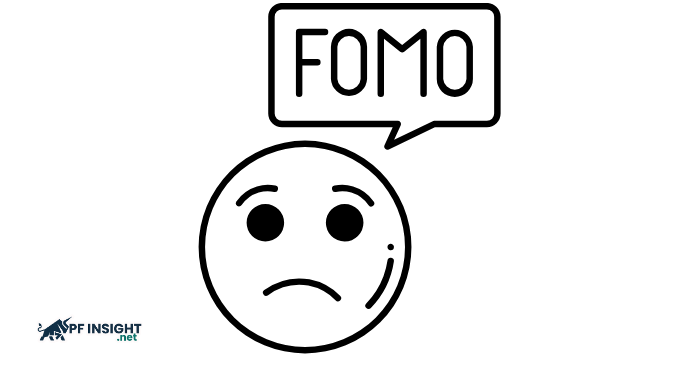
Simply put, FOMO trading means trading out of fear of being left out of the market. Traders see the price moving strongly and believe the move will continue, so they rush into a trade even though they are not fully prepared.
In FOMO trading, the question is no longer whether this is a good entry point, but whether the price will keep moving if they do not enter immediately. This shift in how the question is framed is what makes traders more likely to make poor decisions.
How FOMO trading is different from planned trades
The difference between FOMO trading and planned trading lies in the order of decision-making. With a planned trade, traders define in advance:
- Entry conditions
- Stop-loss level
- Expected profit target
A trade is executed only when the market meets those conditions.
In contrast, with FOMO trading, traders enter a position first and then try to find reasons to justify their decision. Any plan, if it exists at all, is often adjusted hastily to fit the open trade, rather than guiding the decision from the beginning.
Why beginners chase fast price moves
For beginners, fast price movements often create the feeling that the market is offering a clear opportunity. When prices rise sharply in a short period of time, many beginners believe this is a sign of a strong trend and that entering immediately is a reasonable decision.
However, chasing price does not come from a single cause but from a combination of several common psychological factors.

Fear of missing out on opportunities
The most common reason beginners chase price is the fear of missing out on opportunities. When they see price moving quickly, new traders often worry that if they do not enter immediately, the market will continue moving and they will lose their chance to participate. This feeling makes staying out of the market more uncomfortable than accepting the risk of a late entry.
Misunderstanding price momentum
Many beginners misunderstand the concept of momentum. They assume that a rapid price increase means the price will continue rising, while in reality, strong short-term moves often occur after the market has already traveled a significant distance. Failing to distinguish between sustainable momentum and short-term volatility makes beginners more likely to confuse opportunity with risk.
Influence of social media and trading communities
Social media and trading communities also contribute to price-chasing behavior. Images of quick profits, shared winning trades, or confident market predictions can create psychological pressure on beginners. When they see others already “in a trade,” many beginners feel the need to join, even when they do not fully understand why the trade was entered in the first place.
Common signs of FOMO trading in beginners
FOMO trading among beginners often does not appear as a clear, deliberate decision but instead shows up through familiar behaviors during the trading process. Some common signs include:
- Feeling the need to enter immediately: When the price starts moving quickly, traders feel that if they do not enter right away, they will miss the opportunity. The decision is made in a rushed state, with no time to review the trading plan.
- Entering after the price has already moved a long distance: Instead of waiting for a proper entry, traders accept a late entry just to avoid being left out of the market, even though they know the risk is now higher.
- Failing to clearly define a stop loss before entering: Because the entry happens too quickly, the stop loss is either ignored or added afterward based on emotion rather than planning.
- Making decisions based on short-term price fluctuations: Each new candle or small price movement becomes a reason to act, rather than evaluating the broader market context.
- Adjusting the plan to justify an open trade: After entering a trade, traders begin looking for reasons to convince themselves that the decision was correct, instead of reassessing it objectively.
Why chasing fast price moves often leads to losses
Chasing fast price movements may create the feeling of capturing opportunities, but in reality, it is one of the most common reasons beginners lose money. Several key factors contribute to this outcome:
- Poor entry quality: When price has already moved sharply, entry points are usually located in high-risk areas. Traders end up buying high or selling low, leaving little to no margin of safety.
- Unfavorable risk-reward ratio: Late entries force traders to place stop losses further away to avoid being stopped out, while profit targets do not increase proportionally. As a result, just a few losing trades can wipe out the gains from multiple winning trades.
- Lack of a clear trading edge: Sharp price moves often occur after the market has already priced in most of the information. At this stage, traders no longer have a clear statistical edge and are participating purely based on emotion.
- Emotions overriding the process: Once a trade is entered due to FOMO, traders are more likely to continue making emotion-driven decisions, such as moving stop losses, taking profits too early, or holding losing trades for too long.
- Formation of bad habits: Repeatedly chasing price trains traders to react instead of plan. Over time, this weakens discipline and leads to inconsistent trading results.
Basic ways beginners can avoid FOMO trading
For beginners, avoiding FOMO trading is not about learning new strategies but about changing the approach taken before each trading decision. A simple process can significantly reduce the tendency to chase price.
Step 1. Slow down before entering a trade
When the market moves quickly, the natural reaction is to act immediately. However, slowing down for a few minutes helps traders detach from emotion and return to actual trading conditions.
If there is no time to review the plan, it is very likely not a good trade.
Step 2. Check the trade, not the price
Instead of focusing on how fast the price is moving, check whether the trade meets basic criteria: entry level, stop loss, and acceptable risk.
If you cannot clearly answer these questions, staying out of the market is often the better choice.
Step 3. Accept that missing trades is part of trading
No trader captures every market move. Missing a trade does not affect long-term results as long as discipline and consistency are maintained.
For beginners, learning to stay out of the market is a skill just as important as learning how to enter trades.
Conclusion
Understanding FOMO trading meaning helps beginners realize that the problem does not lie in the market or the speed of price movements, but in how they react to those movements. When trading decisions are driven by emotion rather than process, results tend to be unstable and difficult to improve over the long term.
For beginners, the goal is not to participate in every market wave but to build disciplined decision-making habits. When traders learn to slow down, accept missed opportunities, and prioritize entry quality over speed, the influence of FOMO trading gradually diminishes in their trading process.
Read more trading knowledge articles in Trading Basics.