
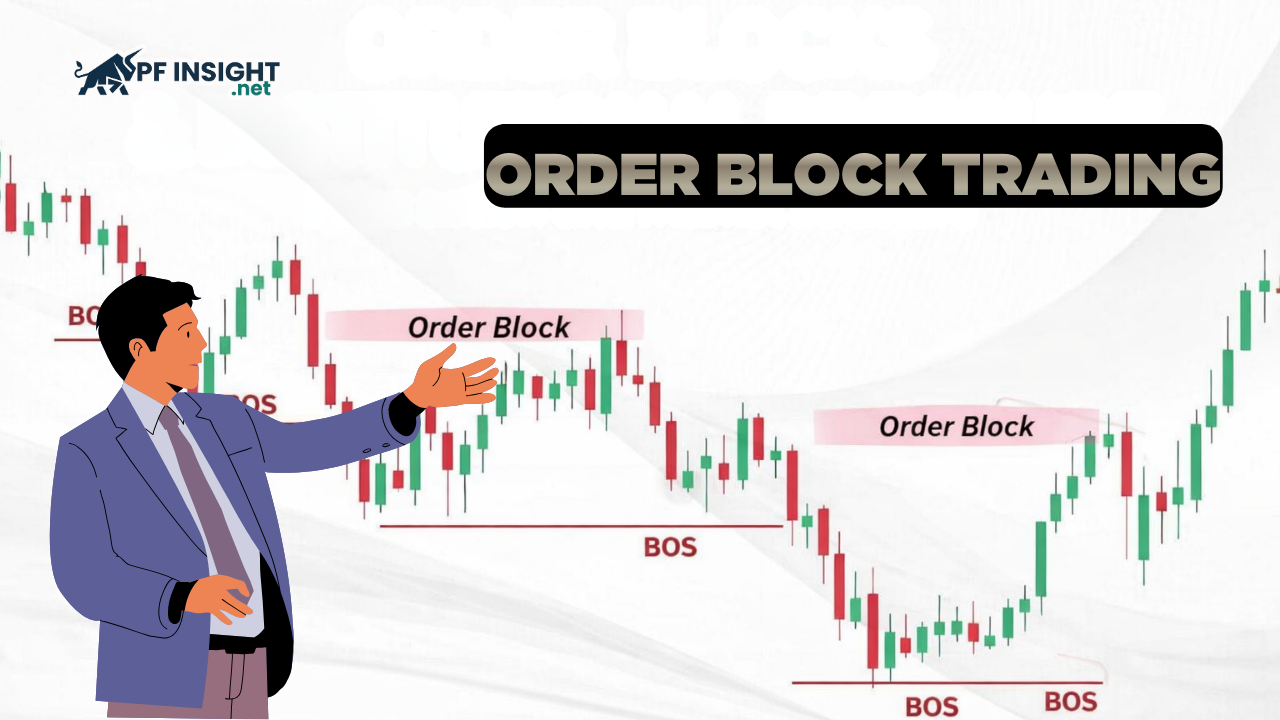
In technical analysis, order block trading is often viewed as a tool for identifying price zones where large institutions are active. However, order blocks should not be understood as standalone trading signals but rather as the result of buying and selling pressure formed during the execution of large-scale orders.
In today’s article, Pfinsight.net analyzes how order blocks reflect institutional buying and selling pressure through price action and market structure, instead of treating them as isolated trade setups.
- Manual trading explained: advantages, risks, and when to use it
- A step-by-step guide to Copy Trading for new traders
- Execution speed & slippage in Prop Trading – How they impact your profits?
What is order block trading in technical analysis
Defining order blocks from a price action perspective
In technical analysis, an order block is understood as a price zone where strong buying or selling pressure emerged and led to an impulsive price move. From a price action perspective, an order block does not represent a trade entry zone but rather reflects the point where supply and demand became sufficiently imbalanced to create a clear shift in market structure. These zones often form just before a breakout phase, when price leaves consolidation and transitions into a directional move.
Distinguishing order blocks from supply and demand zones and support and resistance
Although they may appear similar in form, order blocks differ from supply and demand zones and from support and resistance in how they are formed. Support and resistance are identified based on repeated price reactions over time, while supply and demand zones focus on areas where strong reversals occur. Order blocks, by contrast, emphasize the context of formation and the role of buying and selling pressure in driving price movement. In technical analysis, order blocks only become meaningful when analyzed alongside price action and market structure, rather than being used as static technical levels.
Institutional buying and selling pressure in price action
Institutional buying and selling pressure is not identified through a single indicator but inferred from recurring characteristics in price behavior. These signs appear when large orders are absorbed and distributed within real market liquidity conditions. Common manifestations in price action include:
- A clear expansion in candle range, indicating an imbalance between supply and demand.
- Impulsive price movements, where price moves consistently in one direction over a short period of time.
- Price breaking away from a narrow consolidation zone, reflecting the completion of order distribution.
- The maintenance of structure after a pullback, showing that buying or selling pressure remains active.
These signals only carry meaning when evaluated together and placed within the context of the overall market structure. In this way, price action serves as evidence of institutional pressure, rather than a tool for predicting price reactions at a specific level.
How order blocks form and reflect institutional activity
Order blocks do not form at the moment the price breaks out, but during the phase when the market is absorbing liquidity. This is when large orders are gradually distributed, causing price behavior to become compressed and lack clear direction for a short period of time. These price zones reflect the transition from a state of balance to an imbalance between supply and demand.
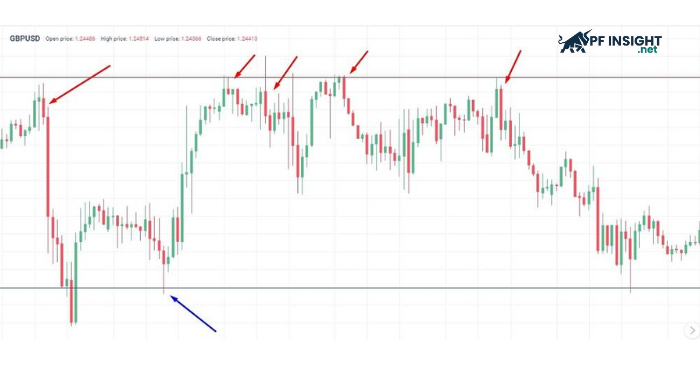
Once the distribution process is complete, price begins to move away from the consolidation area with greater range and speed, showing that the imbalance has clearly formed. The price zone where this compression previously occurred becomes the foundation of the order block, representing the point at which buying or selling pressure was strong enough to alter market structure.
The significance of an order block does not lie in the price zone itself, but in how the market reacts when price returns to test that area. If structure is maintained and the prior directional move remains intact, this suggests that institutional activity is still in effect. In contrast, if price quickly moves through the zone, it reflects a weakening of the original buying or selling pressure.
Validating order block trading using market structure
An order block only has meaning when it is evaluated within the context of market structure. Identifying a price zone without considering how structure forms and breaks can easily lead to subjective interpretation. Market structure provides a reference framework to confirm whether an order block truly reflects buying or selling pressure strong enough to influence price behavior.
Structural confirmation of order blocks
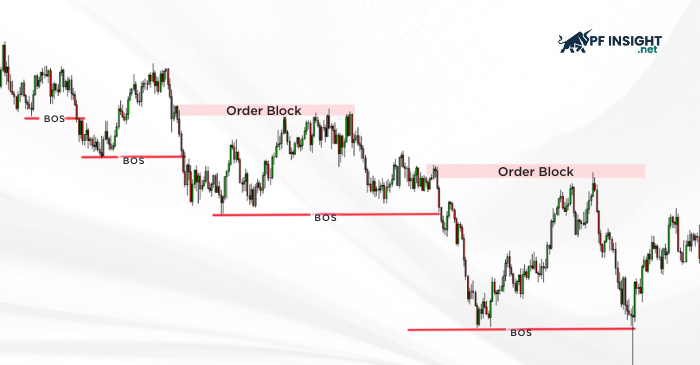
An order block becomes more reliable when it is associated with a break of structure in the direction of the primary move. The presence of a BOS shows that the market has moved away from its prior balance state, while the order block reflects the area where institutional pressure was distributed and left its footprint on price action.
Common confirmation factors include:
- Break of structure (BOS) that signals a clear change in price behavior.
- The order block is located within or near the area where a new structure forms, rather than being detached from context.
- Price maintains structure after leaving the order block, instead of reversing immediately.
Timeframe alignment and context
The reliability of an order block increases when there is alignment across timeframes. An order block formed on a higher timeframe only becomes meaningful when price reactions on lower timeframes align with the established structure.
Key aspects to consider include:
- The position of the order block within the higher timeframe structure.
- Lower timeframe price reactions when price returns to the order block area.
- The ability of price to maintain or break structure after the reaction.
Validating order blocks through market structure helps keep the analysis focused on evidence visible in price behavior, rather than treating order blocks as static price zones or standalone trade setups.
Limitations and context dependency
Order block trading is not a standalone tool
Identifying an order block zone without placing it within the broader market context can easily lead to subjective interpretation, especially during periods when price behavior lacks clear direction.
Unclear market structure reduces the reliability of order blocks
When the market is ranging or experiencing noisy volatility, order block zones may be penetrated without producing any meaningful reaction, reflecting buying or selling pressure that is not strong enough to sustain an impact on price structure.
Timeframe selection plays a decisive role in evaluating order blocks
An order block formed on a lower timeframe can lose its validity when viewed within the trend context of a higher timeframe, particularly when there is no alignment between timeframes.
Order blocks reflect price behavior within a specific phase, not forecasts of future movement.
Analysis should focus on actual price reactions and the ability of structure to be maintained, rather than assuming that the market will always respond in the same way under all conditions.
Conclusion
Order block trading reflects how institutional buying and selling pressure is expressed directly through price behavior and market structure, rather than serving as an independent trading signal. When placed within the context of price action and market structure, order blocks help traders better understand the process of large capital allocation and distribution. This approach emphasizes analyzing price reactions and structural continuity, rather than predicting fixed reversal points.
To explore more in-depth analysis on related topics, you can read additional articles in our Technical Analysis section.