

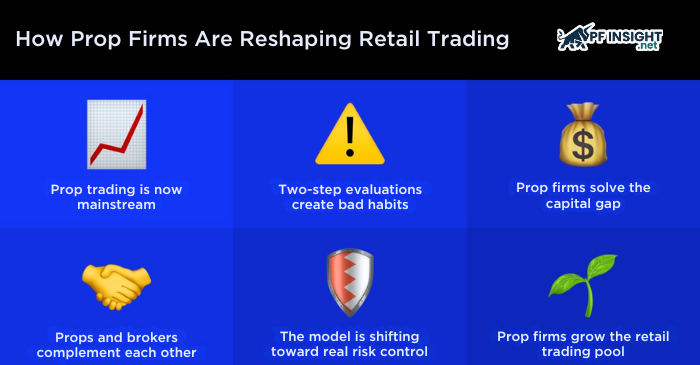
Proprietary trading is no longer a short-term trend but has become a core pillar of the retail trading ecosystem. Despite ongoing controversy around the two-step evaluation model, prop firms play a central role in expanding access to capital, training traders, and revitalizing traditional brokers.
Prop trading is not a passing phenomenon, but an inevitable future
At the Finance Magnates London Summit, a debate between Drew Niv (AFTX) and Brendan Callan (Tradu) centered on the question, “Is prop trading good for the trading industry?” clearly highlighted the divide in how this model is perceived.
One side views prop trading as a natural evolution of retail trading, similar to the early days of Forex in the late 1990s. The other side points to existing issues such as arbitrary profit targets, gambling-like behavior, and system abuse.
However, the core issue does not lie in the nature of prop trading itself, but in how the evaluation model is implemented. While traditional brokers struggle to address the biggest barrier faced by retail traders, namely lack of capital, prop firms have directly filled this gap by offering opportunities that were previously available only to a small minority.
When the two-step evaluation model becomes a structural weakness
In practice, the current two-step evaluation model unintentionally encourages traders to look for shortcuts. From a mathematical perspective, the system can be exploited, forcing firms to respond with punitive measures such as strategy restrictions, IP tracking, or payout denials.
The result is an adversarial relationship between traders and prop firms, which erodes trust. When traders are required to achieve a 10 percent profit within a short time frame simply to avoid losing their fee, they are not learning sustainable trading practices but rather controlled gambling behavior.
That said, this does not invalidate the role of prop trading. On the contrary, it shows that the industry is entering a maturation phase, where evaluation criteria must shift away from short-term profits toward consistency, risk management, and trading discipline.
The symbiotic relationship between prop firms and brokers
Prop firms and brokers are not competitors but complementary components of the same ecosystem.
- Brokers provide infrastructure, liquidity, and market access.
- Prop firms provide capital, training, discipline, and growth opportunities.
Without prop firms, brokers would serve only a small group of traders who already have sufficient capital, leading to stagnation. In contrast, prop firms expand the trader base, develop genuinely skilled traders, and reintegrate them into the broker ecosystem as higher-quality market participants.
The 100,000 USD example clearly illustrates this role. To generate 2,000 USD per month with a professional return of 2 percent, a trader needs 100,000 USD in capital, a figure far beyond the reach of most individuals. Prop firms act as the bridge that separates skill from capital, allowing talented traders to prove their ability without risking their entire personal finances.
Conclusion
Proprietary trading is not a system disruptor but an inevitable evolution of retail trading. When properly standardized, prop trading will not only survive but also shape the next generation of traders, portfolio managers, and market professionals.
Brokers can adapt and grow in synergy with prop firms or remain on the sidelines and gradually become obsolete. The revolution has already begun, and the market has made its choice.