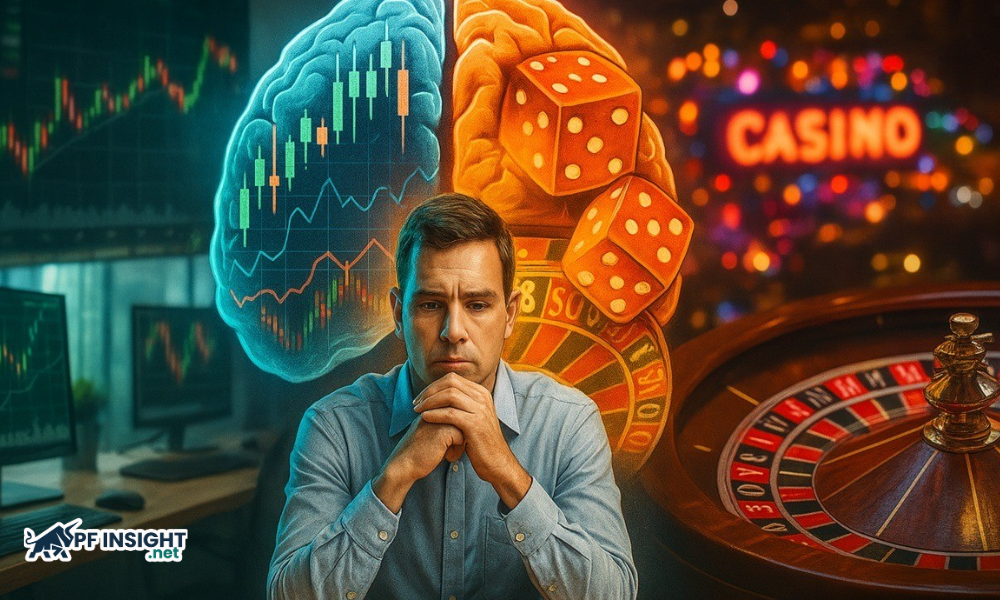
Many newbies often confuse trading and gambling, leading to great risks in investing. While trading is based on analysis and risk management, gambling depends more on luck and emotions. In this article, PF Insight will guide you on how to distinguish and evaluate risks, helping new investors build smart strategies and manage capital effectively.
Although both trading and gambling involve risking money, they are not the same. Trading is a process based on analysis and learned strategy, while gambling is largely based on randomness and luck. Understanding this difference is an important first step for anyone who wants to achieve lasting financial success.
Learn about trading vs gambling
What is trading?
Trading is the act of buying and selling financial assets in the market with the aim of profiting from price fluctuations. Traders use technical analysis, fundamental analysis, or a combination of both to make decisions. Unlike gambling, trading is based on strategy, data, and risk management.
Popular types of trading:
Forex: Forex is the global market for trading currencies, with popular pairs such as EUR/USD or USD/JPY. Operating 24/5, with high liquidity and constant volatility, Forex offers the opportunity to make profits but also comes with high risks.
Stocks: Stock trading is the buying and selling of stocks on the stock exchange. Investors take advantage of price fluctuations and dividends to make profits, while applying risk management strategies.
Crypto: Trading of cryptocurrencies like Bitcoin or Ethereum, with highly volatile markets that are open 24/7.
CFD: A form of trading based on the price fluctuations of assets without direct ownership. Traders can trade on many types of assets such as stocks, commodities, indices, cryptocurrencies.
The difference between trading and gambling is not only in the method, but also in the psychology. A good trader needs emotional stability, discipline and patience, which gamblers often lack. Professional traders learn to manage their emotions and stick to a set strategy. Changing their attitude from impulsive to planned is key to controlling risk and building lasting success.
What is gambling?
Gambling is the activity of betting on the outcome of events based largely on chance, probability, or luck. It is a popular form of entertainment but carries a high risk of loss, and is often not based on long-term analysis or strategy.
Popular forms of gambling:
Casino: Usually includes games like slots, blackjack, roulette or baccarat that offer excitement and the chance to win big. While some games have strategy, the outcome is still largely based on luck, and the risk of losing cannot be completely eliminated.
Poker: Poker is a game that requires both skill and luck. Players need to observe their opponents, manage their capital and make accurate decisions. However, the results are still greatly influenced by the randomness of the cards, so poker is still considered a form of gambling.
Betting: Betting applies to sports, eSports or entertainment events. Players predict the results to place bets, but the final result still depends on luck.
Lottery: Lottery is a popular form of gambling with very low winning odds, but big rewards. Players buy tickets and wait for the draw results, there is absolutely no strategy or skill to influence the results, so the risk of loss is almost certain.
These forms of entertainment focus on instant gratification. The joy of winning easily makes players dependent, leading to a cycle of excitement – loss of control in decisions. The allure of a quick win is irresistible, but the odds of winning are often in favor of the house, potentially posing a risk of large losses.
Compare trading vs gambling
Trading and gambling both involve risk and money, but are different in nature. Understanding the difference helps investors make smart decisions and manage risks effectively.
Trading and gambling both involve risk and money
Similarities
Risk of loss of capital: Trading and gambling both carry the risk of losing money. Gambling is based on luck, while trading, if not managed properly, can lead to heavy losses.
Psychological effects: Both forms easily stimulate strong emotions such as excitement, fear or joy after victory. These fluctuations appear constantly, so psychological control is a decisive factor for success.
Risky decisions: Both require making choices when the outcome is uncertain. Every betting or trading decision comes with risk and an element of unpredictability.
Differences
Some of the differences between trading vs gambling are as follows:
Purpose and mindset
The main difference between trading and gambling lies in the objective of participation. Gambling is all about entertainment and thrills, where casinos are designed to excite and influence the player’s senses. Participants often place their hopes on luck, seeking instant gratification, while trading focuses on planned profits and risk management.
Traders approach the market with a clear plan and goal in mind. They focus on long-term profits rather than instant excitement. Each trade is viewed as a step in a strategy, taking controlled risks. This approach helps limit strong emotional swings, which is completely different from the unexpected and thrilling experience of gambling.
Capital management
Risk management is the key factor that makes the difference between trading and gambling. In trading, each order has a clearly defined stop loss level and risk ratio. In contrast, gambling is based on the “all or nothing” mentality. When losing, players often increase their bets in the hope of recovering, but the result is often a loss of control and more losses.
In the world of trading, risk management is the foundation of survival. Successful traders never bet everything, they carefully calculate the risk-reward ratio, limit losses and set stop-loss for each trade. Reasonable capital allocation, portfolio diversification and discipline help them survive in the long run, instead of betting on emotions like in gambling.
Decision-making basis
The element of skill plays a very small role in gambling. Games like roulette and slot machines are completely random and cannot be predicted or controlled. Even games with an element of strategy like poker give the casino a statistical advantage. After all, luck is short-lived and cannot last forever.
Unlike gambling, trading requires skill, strategic thinking and patience. Traders need to master analytical tools, understand price movements, news and macro trends. They do not act impulsively but based on a plan. Over time, this experience helps them improve their ability to forecast and control risks more effectively.
Emotional discipline
Trading vs gambling shows that emotions are the biggest enemy in gambling. When losing, players often lose control and increase their bets in the hope of recovering their capital. When winning, they get caught up in greed. Both lead to high-risk behavior and end up losing all their capital.
Professional traders keep emotions out of their investment decisions. They use quantitative strategies, automated orders, and journaling to stay objective. By following rules, they avoid impulsive decisions, maintain consistent performance, and
sustainable development in a volatile market environment.
Long-term perspective
The sustainability factor is the clear line between trading and gambling. Gambling is short-term, where the outcome depends entirely on luck. Over time, the house’s mathematical advantage makes it impossible for players to win forever. The longer the game lasts, the higher the chance of losing money, making it impossible to maintain profits. When done correctly, trading is not just a short-term job but a long-term journey. Traders who know how to manage risk, optimize compounding profits and hone their skills can sustain a long-term career. Gambling, on the other hand, often leads to quick failure.
Signs that you are trading like a gambler?
Signs that you are trading like a gambler?
Many investors wonder: “When does trading stop being an investment and become gambling?” In fact, this happens when decisions are no longer based on analysis or strategy, but only on excitement, fear or greed. Once emotions are out of control, trading stops being an investment and becomes gambling.
Too many trades: In trading vs gambling, when traders place too many orders, risking capital just to make quick profits, they stray from a systematic strategy, turning trading into a game of chance similar to gambling. This increases the risk of loss significantly.
No plan: Making orders based on a gut feeling or hoping for luck, instead of a clear strategy. This increases the risk of loss significantly.
Trading on herd mentality: When dealing with trading vs gambling, following the crowd or the market euphoria is a trap. Abandoning personal analysis to follow the crowd can easily lead to bad trading decisions. Independence and discipline are the keys to minimizing the risk of loss.
Ignoring capital protection: Not using stop-loss orders and taking excessive risks on each trade is extremely dangerous. This undisciplined action puts you at risk of quickly blowing up your account. Therefore, it is necessary to set strict risk limits to protect your account.
In trading vs gambling, even experienced traders can get caught up in herd trends or market emotions. They then make impulsive decisions, fall into a gambling-like loop, and face the risk of serious losses.
Safe methods to limit risks when investing
If you are considering getting into trading, here are some proven, effective risk management methods that can help protect capital, limit losses, and maintain long-term profitability in the markets.
Learn and understand the market: In trading vs gambling, understanding the market is an important factor. Investing in proper education and following the market developments helps traders make informed decisions, reduce risks and avoid turning trading into a game of chance.
Regularly review and analyze results: Reviewing trading history and carefully analyzing failures is a necessary step for continuous improvement. This learning process helps to refine strategies and improve performance. By turning failures into lessons, traders can build a more effective trading method for the future.
Controlling your trading psychology: In trading vs gambling, controlling your emotions is paramount. Traders need to recognize and control signs such as panic selling or overtrading. Because a stable psychological state helps ensure that all decisions are based on analysis.
Build a clear trading strategy: Having a comprehensive trading strategy, clearly defining rules for entering orders, taking profits and especially risk management, will create a protective barrier. This strategy helps prevent thoughtless and emotional actions, maintaining consistency to achieve the set profit target.
Useful tips for market newcomers
Useful tips for market newcomers
Here are some practical and basic tips for those new to both trading and gambling. Applying these principles will help you manage your risks better and make responsible decisions from the start.
Set realistic trading goals: Set realistic financial goals for your trading vs gambling success. Setting reasonable expectations will help you maintain discipline and patience, which are key to a sustainable trading career.
Start with a small capital: When you are just starting out, trade with a small investment. This strategy is to learn the real market while minimizing the risk of losing capital. Consider this small capital as a learning cost to gain experience without losing too much.
Do detailed analysis before entering the market: Always analyze the asset thoroughly: check the financial data, history and current market trends. This research is the foundation for making the most informed investment decisions.
Stay up to date with the latest economic and financial news: Keep a close eye on economic events and news that may impact the markets you trade. Having a comprehensive understanding of the latest developments allows you to accurately assess the situation and make more timely and effective decisions.
Use capital protection tools: To be successful in trading vs gambling, use tools like stop-loss orders. This technique helps you protect your assets by managing potential losses ensuring profits accumulate over time.
Focus on smart investing instead of gambling: Gambling can be entertaining but often comes with high risks and financial losses. The difference between trading and gambling is that trading can be a long-term source of profit if the investor applies the right techniques and understanding. Choosing educated trading instead of gambling is a smarter financial approach in the long run.
Set limits and maintain financial control: Before gambling, practice discipline: decide how much money you are willing to spend and never go over it. This will help you control your finances and avoid getting carried away and overspending.
Conclude
The clear difference between trading vs gambling lies in the foundation. Trading is a principle-based activity that requires data analysis, setting stop-losses, and maintaining realistic expectations. Gambling, on the other hand, relies on random chance. To protect their assets, traders should consistently apply discipline and strategy, understanding that trading is a long-term process, not a quick hit.